Stories · Barcelona
Gaudí designed the Sagrada Família upside down
Gaudí found the shape of his arches by hanging weights from strings and turning the photograph over. The columns of the Sagrada Família grew from it.
2 min read

Stories · Barcelona
Gaudí found the shape of his arches by hanging weights from strings and turning the photograph over. The columns of the Sagrada Família grew from it.
2 min read
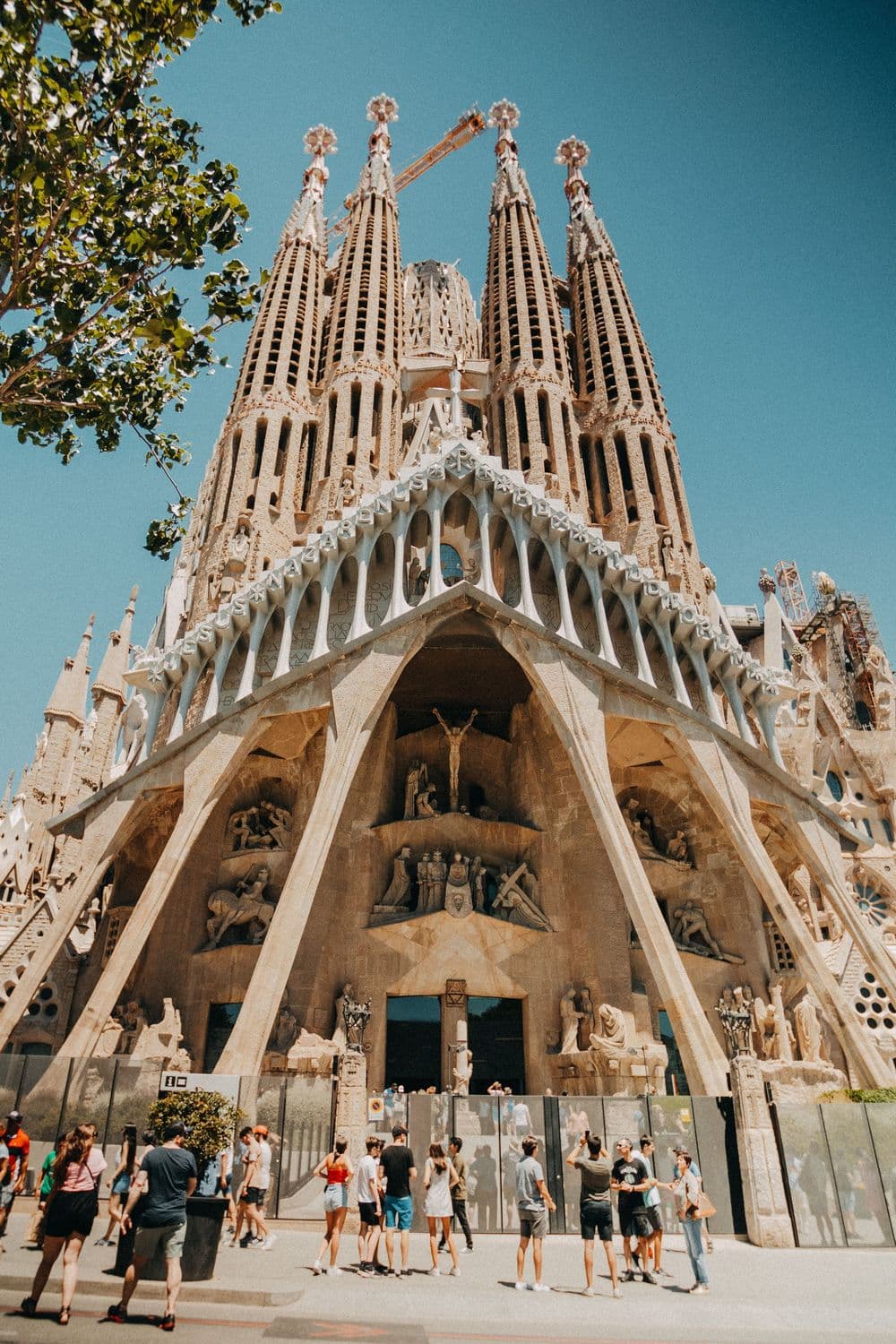
Walk into the Sagrada Família and the first thing you notice is that it feels like a forest. The columns lean slightly and split into branches as they rise, and the ceiling spreads out above you like leaves with light coming through.
It looks like decoration. It's actually engineering, and Antoni Gaudí, the architect, worked it out upside down.
Gothic cathedrals are held up from the outside by flying buttresses, the stone arms propping up their walls. Gaudí wanted to get rid of them. He wanted columns that carried the weight straight down, along the lines the forces actually follow.
He found those lines with string. For a church at the Colònia Güell, a factory village outside Barcelona, he spent about ten years on a hanging model. He hung strings from a board and, from them, small bags filled with lead shot, each weighted to match the load of the real building.
Gravity pulled every string into the shape of a perfect arch in tension. Gaudí photographed the model, turned the photograph upside down, and had the shape of a building that would stand in compression.
That church was never finished. What he learned from it shaped the columns of the Sagrada Família, which are even made of different stones depending on the load they carry. The strongest, at the crossing, are hard red porphyry.
Gaudí never saw this interior. When he died in 1926, there were no walls here at all. The nave was built in the decades that followed, from his plaster models and the principles he left behind. Its roof was finished only in 2010.
Even the models nearly didn't survive. In 1936, at the start of the Spanish Civil War, revolutionaries broke into his workshop, burned the drawings and smashed the plaster models. One of his assistants collected thousands of fragments and, after the war, began piecing them back together. Many of the models in the museum downstairs are those same pieces, with the joins still visible.
Go in and walk to the centre of the nave, among the columns. Look up and follow one column from the floor as it splits into branches. Then find the thickest, darkest columns at the crossing: those are the porphyry ones carrying the most weight.
Before you leave, go down to the museum near the exit and find the plaster models. Look for the cracks where broken pieces meet.
The Trevlo tour of the Sagrada Família starts in the park across the road and takes you through the Nativity façade, the nave, the Passion façade and the models. Six stops, about twelve minutes of listening, at your own pace.
The first stop is free to play on this page, and your first tour in the app is free.