Stories · New York
Who designed Central Park?
Frederick Law Olmsted and Calvert Vaux. Their Greensward plan, handed in minutes before the 1858 deadline, beat 32 rival designs for the park.
2 min read

Stories · New York
Frederick Law Olmsted and Calvert Vaux. Their Greensward plan, handed in minutes before the 1858 deadline, beat 32 rival designs for the park.
2 min read
Central Park was designed by Frederick Law Olmsted, a farmer and journalist with no training in design, and Calvert Vaux, a young architect from London. They called their plan Greensward, and they very nearly missed the deadline with it.
In 1853 New York decided to build a great park in the middle of Manhattan, on rocky, swampy land far north of the city of the day. The city took the land by eminent domain. About 1,600 people had to leave, among them the residents of Seneca Village, a community of mostly African American property owners founded in 1825.
Olmsted needed a job. He had farmed on Staten Island, gone to sea as an apprentice sailor, and travelled the South writing for the New York Daily Times. Then the publishing firm he had joined failed in the Panic of 1857. That September the park board hired him as superintendent, to clear and drain the site.
The park's commissioners had announced a competition for its design. Vaux, who knew Olmsted only slightly, suggested they enter together. Olmsted knew the site from his day job, and Vaux was a trained architect.
They worked nights and weekends through the winter of 1857 and 1858. Vaux's son later remembered that anyone who helped with the drawings was set to adding grass. The rules asked for at least four roads across the park, a parade ground, a formal flower garden and a place to skate.
Olmsted and Vaux found an answer to the roads that made their name. They sank the cross-town roads below the level of the park, so the traffic would pass through out of sight. Above, they drew countryside: meadows, woods and curving paths. The one formal feature was a straight promenade lined with trees, today's Mall.
The deadline was 1 April 1858. Late on the evening of 31 March, the two men carried twelve presentation boards to the Arsenal building in the park. They had to wake the caretaker to take them. Their entry was logged as number 33, under the name Greensward.
Thirty-three plans came in. On 28 April 1858 the commissioners announced the winner: Greensward, with a prize of $2,000. The Lake opened for skating that December, and building went on for about fifteen years.
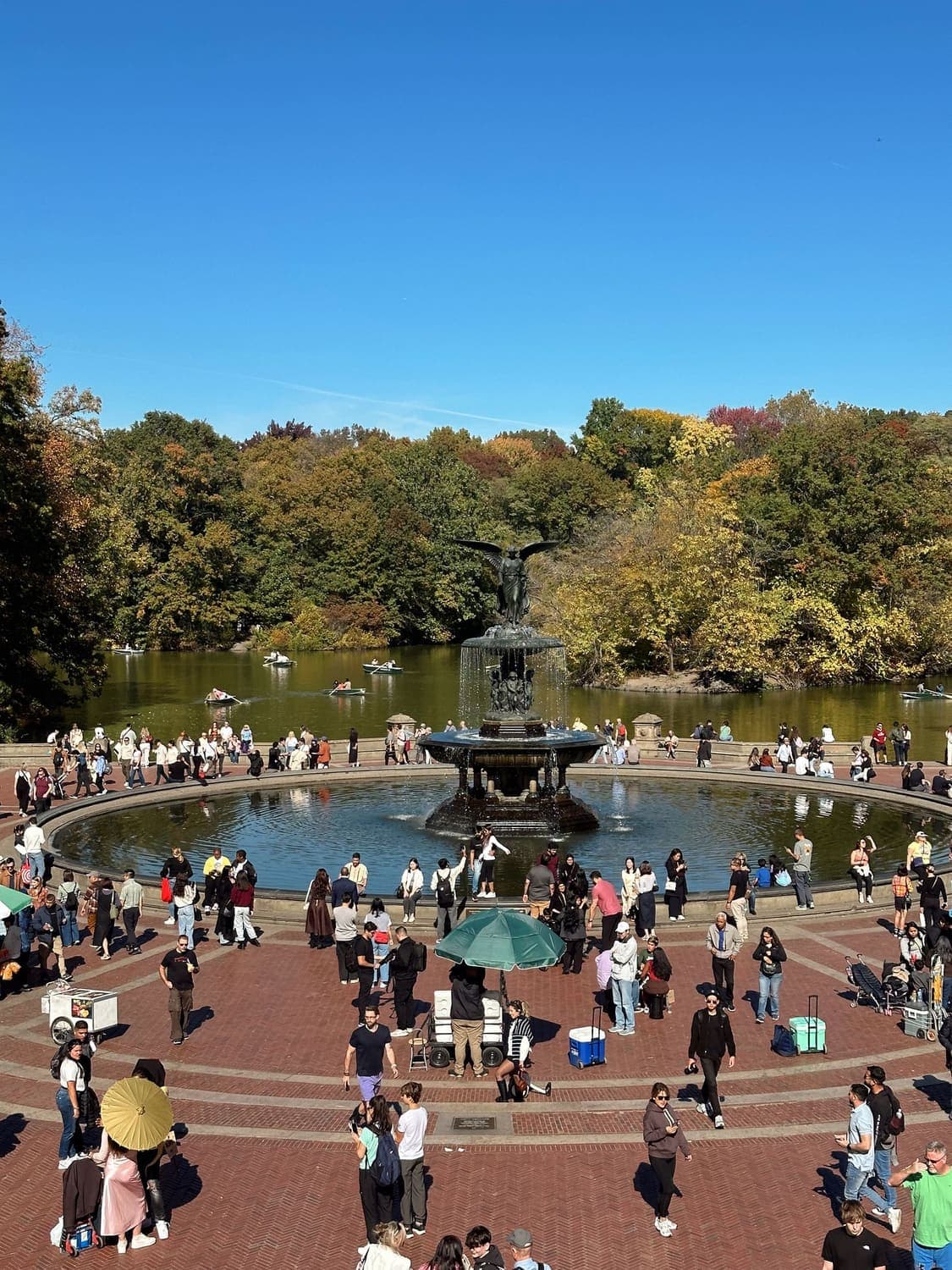
Start at the south end of the Literary Walk, the straight path of the Mall, beside the statue of Shakespeare. Above you is the double row of American elms on the one straight line Olmsted and Vaux allowed themselves. Walk north under the trees to Bethesda Terrace, which Vaux designed, and look across the Lake to the woods of the Ramble, the wild garden of their plan.
The Trevlo tour Central Park: Bethesda to Belvedere starts on the Literary Walk, where this story is told. It goes on to the carvings of Bethesda Terrace and the angel on Bethesda Fountain, crosses Bow Bridge into the woods of the Ramble, climbs to Belvedere Castle and ends on the Great Lawn, where a reservoir once held the city's drinking water. Seven stops, about nineteen minutes of listening, at your own pace.
The first stop is free to play on this page, and your first tour in the app is free.