Stories · New York
How did they build the Brooklyn Bridge underwater?
Each tower stands on a caisson, a huge upside-down timber box. Compressed air kept the river out while men dug away the riverbed and the tower sank.
3 min read

Stories · New York
Each tower stands on a caisson, a huge upside-down timber box. Compressed air kept the river out while men dug away the riverbed and the tower sank.
3 min read
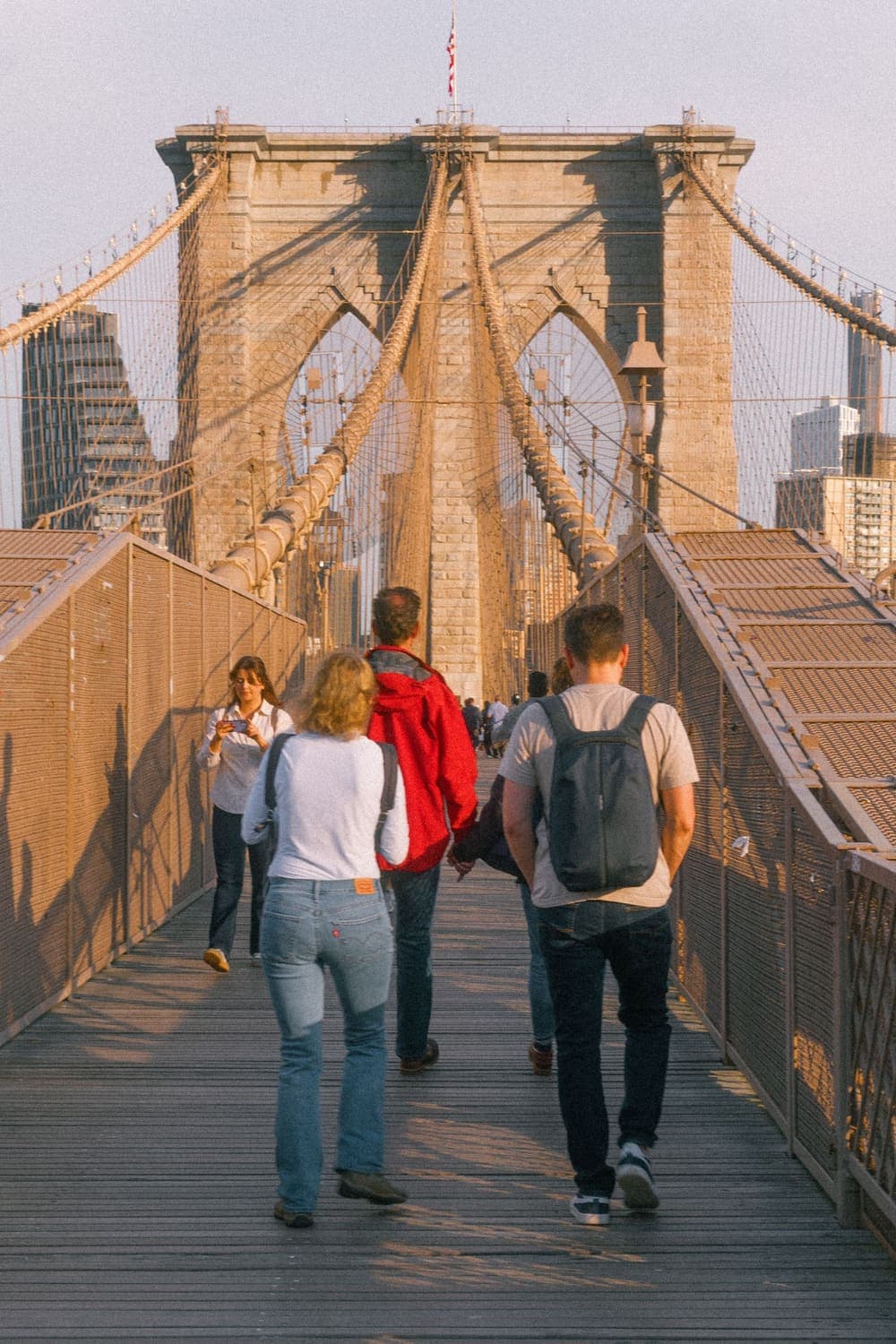
The builders didn't work underwater so much as push the river aside. Each of the two stone towers stands on a caisson, a colossal timber box turned upside down, with no bottom. It was towed into place, sunk onto the bed of the East River and filled with compressed air until the air drove the water out. Inside, men stood on the riverbed itself, digging away the mud and boulders under the box's edges, and the spoil went up through water shafts. Masons on the roof kept adding stone, and the box settled a little at a time. When it reached firm ground, the space the men had worked in was filled with concrete, and the box stayed there for good. Brooklyn's caisson went down 44½ feet below high water, and Manhattan's 78.
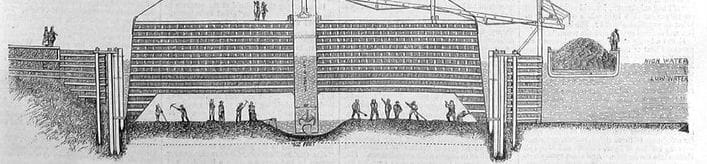
The Brooklyn box came first, launched in March 1870. It covered 17,000 square feet, under a roof of solid timber fifteen feet thick. Men reached it down shafts and through air locks, and worked eight-hour shifts, at first for two dollars a day. Some 2,500 different men passed through it.
What with the flaming lights, the deep shadows, the confusing noise of hammers, drills, and chains, the half-naked forms flitting about, with here and there a Sisyphus rolling his stone, one might, if of a poetic temperament, get a realizing sense of Dante's Inferno.
The squeezed air did strange things. Nobody could whistle in it, and a blown-out candle would light itself again. A workman kept his dinner in an empty candle box, nailed up under a joint in the roof that had been left unfilled, and fetching it, he probably held his candle to the timber. On the evening of 2 December 1870 a fire was found there, burning inside the roof. At eight the next morning a test hole showed that the fourth layer of timber was "one mass of living coals." Fire engines and boats poured in thirty-eight streams of water, and by mid-afternoon the caisson held 1.35 million gallons. The chief engineer, Washington Roebling, was brought up barely conscious, and was back down within days.
Manhattan's box went far deeper, with the air at 35 pounds per square inch, about the pressure in a car tyre. There the danger came on the way up. Under pressure, air dissolves in the blood, and men who came out too fast felt it return as bubbles, with pains they said were like a bullet, or like the flesh being torn from their bones. This was the bends. In four months of 1872 the doctor in charge, Andrew Smith, treated 110 cases, and three men died. Washington was struck himself, and described it in a footnote of his report, in the third person, morphine and all.
In May 1872, at 78 feet, he stopped. Just below lay bedrock, sloping and uneven, and blasting it level would have cost a fortune and a great deal of time. Over the rock lay packed sand and gravel, hard enough to batter an iron rod to pieces. It was, he wrote, "nearly as good as any concrete." Historians add that deeper meant more men hurt. The Manhattan tower has stood on that layer for more than 150 years.
Both caissons are under the walkway. At the Manhattan tower, the path widens into a balcony under the pointed arches, and the box lies far below, under the riverbed. At the Brooklyn tower, you are standing over the caisson that burned.
The Brooklyn Bridge & DUMBO tour walks the promenade from Manhattan to the old Fulton Ferry landing in Brooklyn, nine stops, about 39 minutes of listening. The caissons and the bends are the third stop, and the fire is the fifth.
A free preview of the tour plays on this page, and your first tour in the app is free.