Stories · London
How long did it take to build St Paul's Cathedral?
Christopher Wren's St Paul's Cathedral took about 35 years. The first stone was laid in 1675, and Parliament declared it complete on Christmas Day 1711.
3 min read

Stories · London
Christopher Wren's St Paul's Cathedral took about 35 years. The first stone was laid in 1675, and Parliament declared it complete on Christmas Day 1711.
3 min read
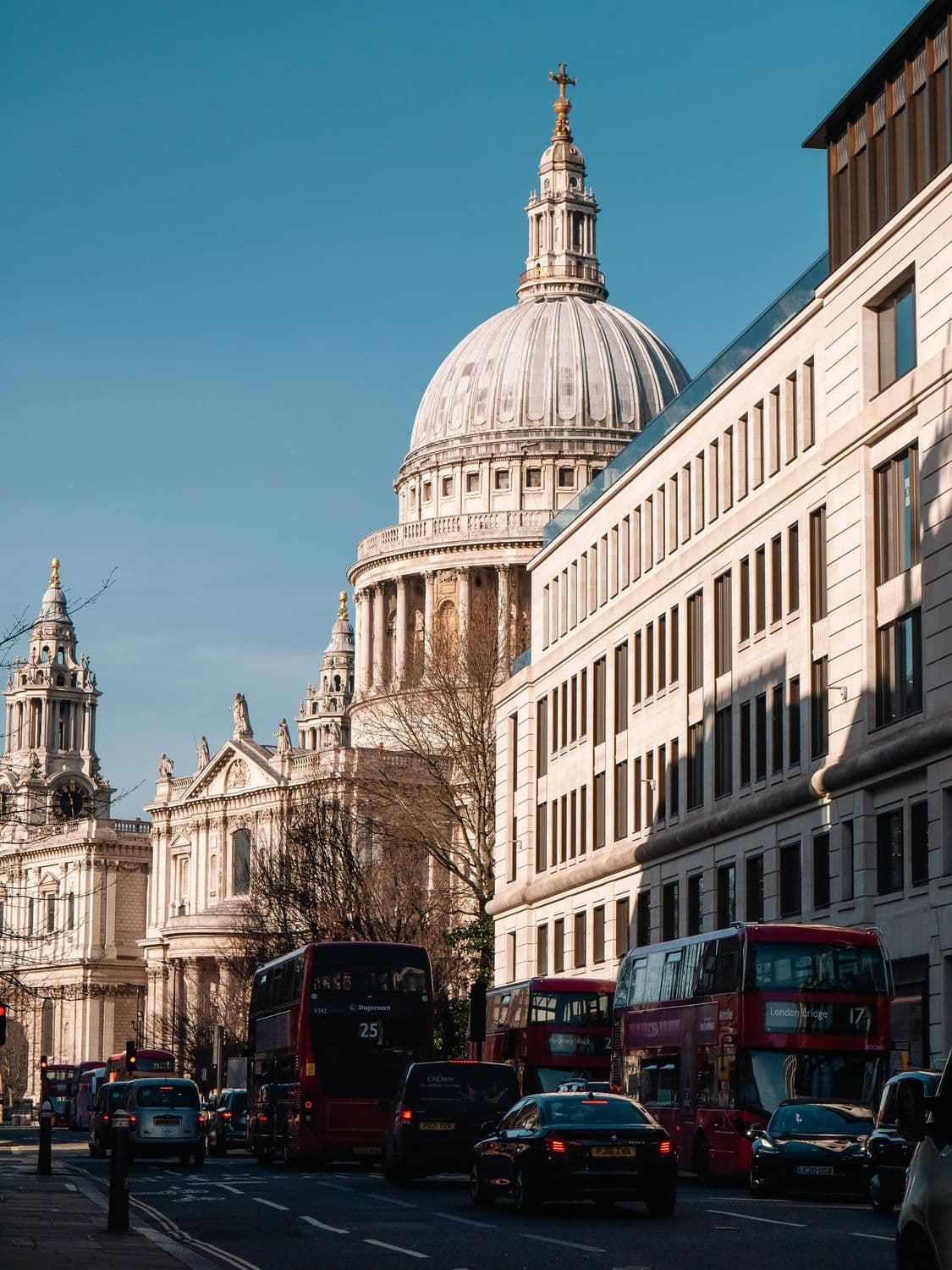
Counted from the Great Fire of London in 1666, which wrecked the old cathedral, it took 45 years. One architect saw it through from start to finish. Wren was 42 when building began and 79 when it was declared finished, and Parliament had kept back half his pay for the last fourteen of those years to hurry him along.
On 27 August 1666, Wren's plan to repair Old St Paul's and give it a dome was approved. A week later the Great Fire of London swept through the city and left the cathedral a roofless shell.
For a while the clergy tried to patch the ruins. In 1668 the decision was taken to clear them. Wren tried a new method: gunpowder. A first charge under one of the tower's pillars worked well. A second, too large, sent stones flying into the street, and the neighbours asked for the explosions to stop. Wren switched to a battering ram.
Wren's favourite design was a church in the shape of a Greek cross, with four equal arms under a great dome. In 1673 he had a big oak model of it made, the Great Model, at a cost of more than £500. The clergy turned it down. They wanted a long nave, like a traditional English cathedral.
In 1675 King Charles the Second approved a compromise, the Warrant Design, with a long nave and a dome topped by a tall spire. The royal warrant let Wren make "variations, rather ornamental than essential". He used that freedom so widely that the building finished in 1711 looks very little like the drawing the king signed.
The first stone went down in June 1675, without any ceremony. While Wren was marking out the centre of the future dome, he asked a workman to bring a stone to mark the spot. The man came back with a piece of an old gravestone from the ruins. It had one word carved on it: Resurgam, Latin for "I shall rise again."
The choir, the eastern end, held its first service on 2 December 1697. That same year Parliament, impatient with the pace, held back half of Wren's salary until the cathedral was finished.
In October 1708 Wren's son Christopher, born the year building began, set the last stone on the lantern that crowns the dome. With its cross, the dome rises 111 metres (365 feet), a foot for every day of the year. Parliament declared St Paul's complete on 25 December 1711, and Wren was finally paid what he was owed.
From the churchyard garden on the south side, with the dome in full view, face the south transept, the arm of the cathedral that juts out towards you. Look up at the triangular pediment above its portico. A phoenix rises from the flames there, carved by the sculptor Caius Gabriel Cibber, with the single word RESURGAM.
Inside, under the dome, the floor carries Wren's epitaph in Latin. It tells the reader who seeks his monument to look around.
The Trevlo tour of St Paul's Cathedral follows Wren's building from the approach up Ludgate Hill to the west front, the nave, the floor under the dome and his plain tomb in the crypt. It ends in the churchyard with the whole dome in view. Six stops, about twenty-nine minutes of listening, at your own pace.
The first stop is free to play on this page, and your first tour in the app is free.