Stories · London
Who is in the Arnolfini Portrait?
The man in Jan van Eyck's Arnolfini Portrait of 1434 is probably Giovanni di Nicolao Arnolfini, an Italian merchant in Bruges. The woman is unidentified.
3 min read

Stories · London
The man in Jan van Eyck's Arnolfini Portrait of 1434 is probably Giovanni di Nicolao Arnolfini, an Italian merchant in Bruges. The woman is unidentified.
3 min read
The National Gallery thinks she was probably his second wife, whose name has not been found. Two more people appear in the round mirror on the back wall, standing in the doorway. One of them is probably the painter. Above the mirror, van Eyck wrote on the wall in Latin: "Jan van Eyck was here. 1434."
The family name comes from an old inventory. In 1516 the painting belonged to Margaret of Austria, who governed the Netherlands for her nephew, the future emperor Charles V. Her inventory calls the man "Hernoul le Fin", a garbled form of Arnolfini.
There were several Arnolfinis trading in Bruges, a rich port in what is now Belgium. From 1861, and for more than a century after, the favourite candidate was Giovanni di Arrigo Arnolfini, with his wife Giovanna Cenami.
Then, in the 1990s, the French historian Jacques Paviot found an entry in the Duke of Burgundy's accounts. The duke had given Giovanni di Arrigo silver pots on his marriage, in 1447. That was thirteen years after the date on the wall, and six years after van Eyck died.
Attention turned to an older cousin, Giovanni di Nicolao Arnolfini, who also traded in Bruges. He had married Costanza Trenta in 1426. Records suggest she was dead by 1433, a year before the date on the painting.
In 1934 the art historian Erwin Panofsky argued that the painting showed a wedding. He read van Eyck's "was here" as a witness's signature, which made the picture a kind of marriage certificate. The idea became famous, and the painting was long called the Arnolfini Marriage. Most scholars now reject it.
Another reading starts from the mirror. Its frame holds ten tiny scenes of the Passion of Christ. The art historian Margaret Koster pointed out that the scenes on the woman's side show Christ's death and resurrection. She suggests the picture remembers Costanza, painted after she died.
One question has a firmer answer. The woman is often taken to be pregnant. The National Gallery's catalogue says she is not. She is holding up the heavy folds of a fashionable gown, and van Eyck painted a virgin saint in the same shape three years later.
From Margaret of Austria the painting passed to the kings of Spain. It next turns up with Colonel James Hay, a Scottish officer. He said it had hung in the room in Brussels where he recovered from wounds received at Waterloo in 1815.
He probably found it in Spain instead. In 1813, after the Battle of Vitoria, British soldiers looted the baggage of Joseph Bonaparte, Napoleon's brother, which was full of paintings from the Spanish royal collection. Hay offered the picture to the Prince Regent, who returned it. The National Gallery bought it in 1842 for 600 guineas.
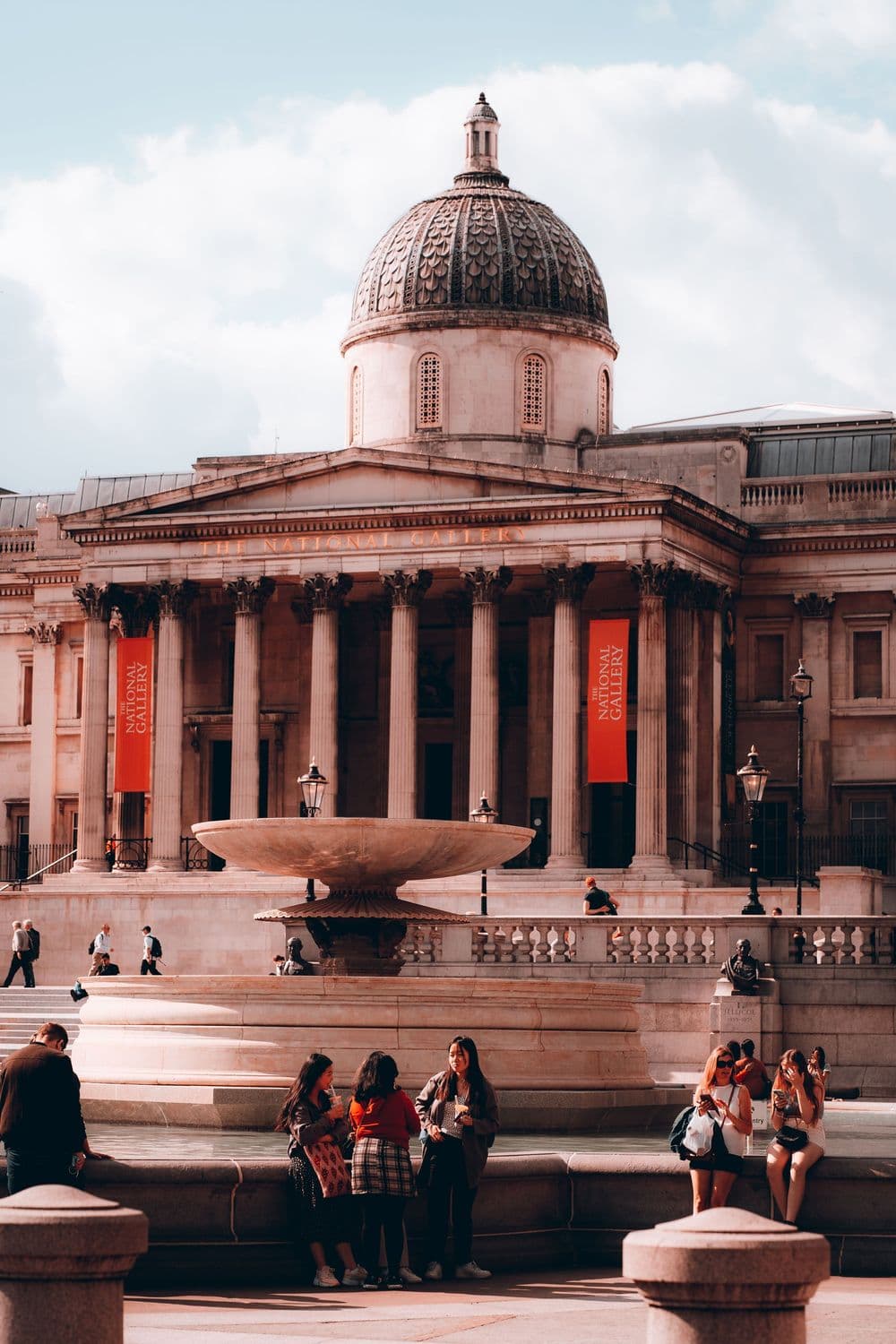
As of October 2026, the painting hangs in Room 52 of the Sainsbury Wing, among Netherlandish pictures of 1420 to 1480. It is smaller than many expect, about 82 by 60 centimetres (32 by 24 inches). Step close to the convex mirror and find the two tiny figures in its doorway.
The Trevlo tour of the National Gallery tells the painting's story in front of it, its second stop. It starts in the entrance hall, then visits Leonardo's Virgin of the Rocks, the Dutch Golden Age rooms and Turner's Rain, Steam and Speed. It ends walking back through the East Wing. Six stops, about twenty-eight minutes of listening, at your own pace.
The first stop is free to play on this page, and your first tour in the app is free.