Stories · London
How was the Rosetta Stone decoded?
The Rosetta Stone repeats one decree in Greek, demotic and hieroglyphs. Scholars read the Greek and matched it to the rest. Champollion cracked it in 1822.
3 min read

Stories · London
The Rosetta Stone repeats one decree in Greek, demotic and hieroglyphs. Scholars read the Greek and matched it to the rest. Champollion cracked it in 1822.
3 min read
The key was the royal names on the Rosetta Stone. Thomas Young, an English physicist, showed that the name Ptolemy, inside its oval frames, was spelled out in sounds. Then Jean-François Champollion, a French scholar who knew Coptic, the last form of Egyptian, proved that hieroglyphs mix sound signs with picture signs.
In July 1799, during Napoleon's invasion of Egypt, French soldiers were rebuilding an old fort near the town of Rashid, which Europeans called Rosetta. An officer, Pierre-François Bouchard, noticed that one broken stone in the wall was covered in writing.
It was a decree by Egyptian priests from 196 BC, honouring the king, Ptolemy the Fifth. It was written three times. Hieroglyphs are at the top, demotic, the everyday Egyptian script, in the middle, and ancient Greek at the bottom. Scholars could read the Greek. Nobody had read hieroglyphs for about fourteen hundred years.
The French didn't keep it. In 1801 the British defeated their army in Egypt, and the stone was handed over under the terms of surrender. It reached the British Museum the following year.
Copies of the inscriptions went round Europe, and the race was on. Young started work in 1814. In the hieroglyphs he noticed groups of signs inside ovals, now called cartouches. The Greek text named Ptolemy, so Young guessed the ovals held his name, and matched some signs to sounds.
He was right, but he thought sound signs were only used to spell foreign names, like that of Ptolemy, a Greek king. Everything else, he assumed, was picture-writing.
Champollion had been learning ancient languages since boyhood. On the morning of 14 September 1822, he received copies of carvings from Abu Simbel, a temple far up the Nile. It is more than a thousand years older than the Rosetta Stone.
One cartouche began with a sun. In Coptic, the word for sun is "re". The next sign he took to be "ms", from the Coptic verb for giving birth. The last two he knew as "s" from the name Ptolemy. Ra-mes-s: Ramesses, the pharaoh who built that temple. An ancient Egyptian name, spelled with sounds. The whole script, he realised, worked that way, with sound signs and idea signs side by side.
The story that's told is that he ran to his brother's office, shouted "Je tiens l'affaire!", "I've got it!", and fainted. It comes from family accounts, written down long afterwards, so it may have grown in the telling. What is certain is that less than two weeks later, on 27 September, he read his findings to the Académie des Inscriptions, the learned society for ancient history in Paris. Thomas Young was in the room.
In Room 4, the Egyptian sculpture gallery, the Rosetta Stone stands behind glass: a dark slab a little over a metre tall, nearly four feet. Look past the hieroglyphs to the Greek at the bottom: that's the part that made the rest readable.
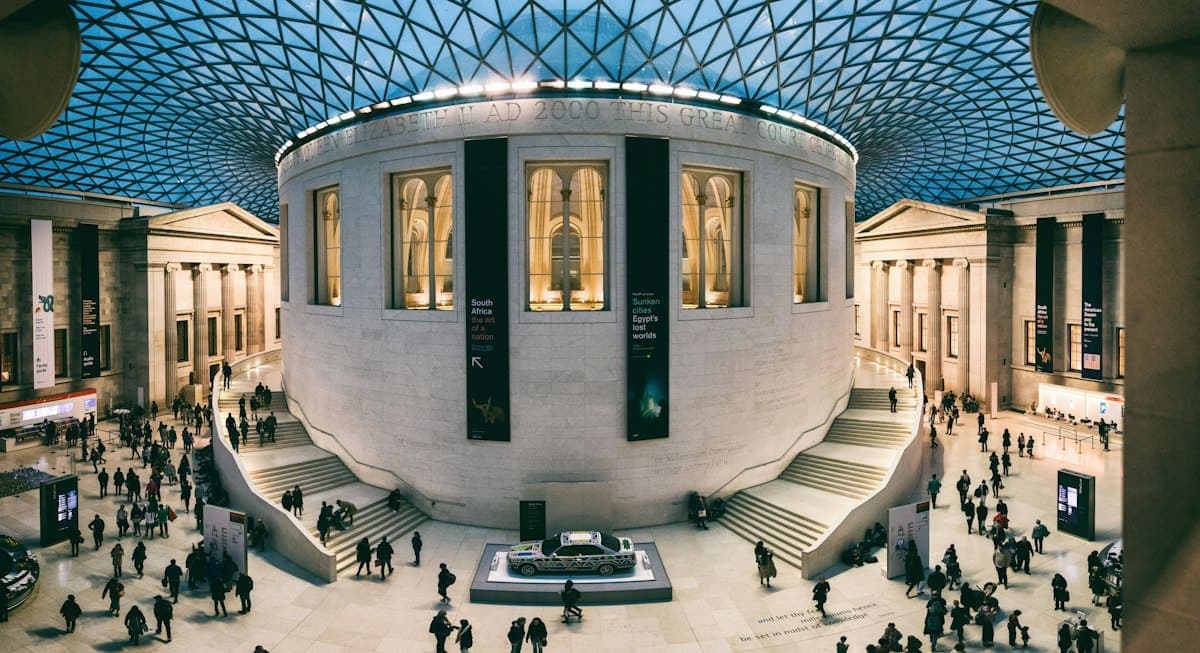
The Trevlo tour of the British Museum tells this story at the stone, its second stop, after the Great Court and the lottery that paid for the museum. Then it takes you to the Assyrian lion hunt, the Parthenon sculptures, the Lewis Chessmen and the Sutton Hoo helmet. Six stops, about thirteen minutes of listening, at your own pace.
The first stop is free to play on this page, and your first tour in the app is free.