Stories · Amsterdam
How was the Secret Annex hidden?
The Secret Annex was the back part of Prinsengracht 263, unseen from the canal. From August 1942 its door was hidden behind a hinged bookcase.
3 min read

Stories · Amsterdam
The Secret Annex was the back part of Prinsengracht 263, unseen from the canal. From August 1942 its door was hidden behind a hinged bookcase.
3 min read
The bookcase was Victor Kugler's idea. He was one of Otto Frank's employees, and houses across Amsterdam were being searched for hidden bicycles. The carpentry was done by Johan Voskuijl, the firm's warehouse manager and the father of Bep Voskuijl, one of the helpers. It hid the way in for two years, until 4 August 1944.
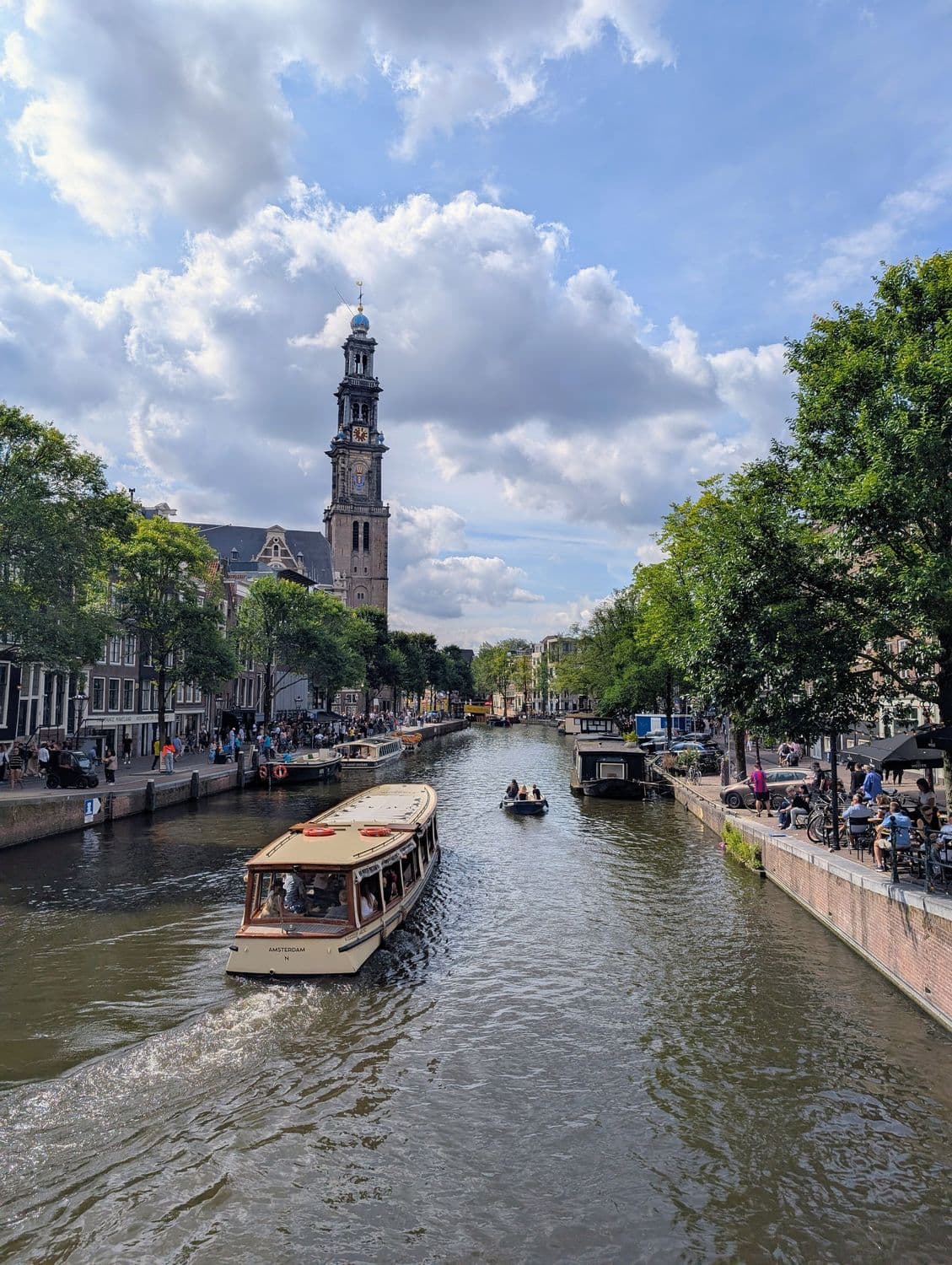
Otto Frank's company sold pectin, used to make jam, and spices. In December 1940 it moved into Prinsengracht 263, a canal house built in 1635. Like many Amsterdam houses, it was two buildings: a front house on the canal and a back house behind it. In Dutch that is the achterhuis, the word translated as the Secret Annex. From the street, nothing shows that it is there.
On 5 July 1942, Anne's sister Margot, aged sixteen, received a call-up to report for a German labour camp. The next morning the Franks went into hiding in the back house. The van Pels family followed on 13 July, and the dentist Fritz Pfeffer in November, making eight people in all.
At first the way in was an ordinary door on a landing, at the top of a wooden staircase. Anne wrote that nobody would guess how many rooms lay behind that plain grey door.
In August 1942 Johan Voskuijl built the bookcase in front of it. It swung out on hinges like a door, and business files on its shelves made it look like office storage. On the hiding side, a wooden bobbin on a rope was used to pull it open and shut. Anne's diary entry of 21 August 1942 begins: "Now our Secret Annex has truly become secret."
Six people outside knew the secret: Miep Gies and her husband Jan, Johannes Kleiman, Victor Kugler, Bep Voskuijl and her father. The warehouse workers were never told, so during office hours the eight had to keep almost silent.
At about half past ten on 4 August 1944, an arrest team from the German security police reached Prinsengracht 263. It was led by Karl Silberbauer, an Austrian member of the SS, with Dutch detectives. They questioned Kugler at his desk, and accounts differ on how they came to the bookcase.
All eight people in hiding were arrested, with Kleiman and Kugler. Whether someone betrayed them, and who, has never been established. A 2022 book named the notary Arnold van den Bergh, but historians rejected its case and the Dutch publisher withdrew it.
After the arrest, Miep and Bep gathered Anne's diary papers from the floor, and Miep kept them in a drawer. Days later, on German orders, a removal firm emptied the annex. Otto Frank was the only one of the eight to survive the camps. Anne and Margot died in Bergen-Belsen in early 1945. When the news reached him that July, Miep gave him Anne's papers.
The bookcase is still on the landing where Johan Voskuijl built it, partly under glass. The museum route leads through the front house to it, and visitors pass through the opening beside it and up the steep stairs into the annex. The rooms beyond are bare. When the museum opened in 1960, Otto Frank asked for them to stay empty, as the Nazis had left them.
The Trevlo tour of the Anne Frank House tells this story at the bookcase, its third stop. It begins outside Prinsengracht 263 and passes through Otto Frank's office. Beyond the bookcase it visits Anne's room, her parents' room and the attic window with the Westerkerk tower in view. Six stops, about twenty-five minutes of listening, at your own pace.
The first stop is free to play on this page, and your first tour in the app is free.