Stories · Bangkok
Is the Emerald Buddha made of emerald?
No. The Emerald Buddha at Bangkok's Grand Palace is carved from a green stone, usually called jade or jasper. "Emerald" describes its colour.
3 min read

Stories · Bangkok
No. The Emerald Buddha at Bangkok's Grand Palace is carved from a green stone, usually called jade or jasper. "Emerald" describes its colour.
3 min read
The seated, meditating Buddha is about 66 centimetres (26 inches) tall, a little shorter than a kitchen counter. In Thai it is Phra Kaew Morakot, and here "morakot", emerald, means green. Its stone has never been scientifically tested. It has been housed in the Temple of the Emerald Buddha, inside Bangkok's Grand Palace, since the 1780s, and is revered as the protector of Thailand.
The first record of the statue comes from Chiang Rai, in what is now northern Thailand, in 1434. By the usual account, lightning struck a chedi, a bell-shaped Buddhist monument, at a monastery there. Inside was a Buddha image covered in plaster.
The abbot took it to his residence. Later he noticed that the plaster on its nose had flaked away, showing green stone underneath.
Legend gives it a much older past: made in India by a sage, with help from the gods Indra and Vishnu. Some art historians instead place its style in northern Thailand in the 1400s.
The statue did not stay put. The story goes that a king of Chiang Mai sent for it, but the elephant carrying it turned three times towards the town of Lampang instead. It stayed in Lampang for 32 years, then moved to Chiang Mai in 1468.
In 1552 King Setthathirath, who had ruled Chiang Mai and became king of Lan Xang in Laos, took it to Luang Prabang. In 1564 he moved it to his new capital, Vientiane. It stayed there for more than 200 years.
In 1779 a Siamese army under General Chao Phraya Chakri captured Vientiane and brought the statue to Siam, as Thailand was then called. It was set up first in Thonburi, the capital at the time. In 1782 Chakri became king, founding the Chakri dynasty, and moved the capital across the Chao Phraya River to Bangkok. He built a temple for the statue inside his new Grand Palace.
So what is it made of? King Mongkut, Rama IV, who reigned from 1851 to 1868, said it was jade. The French art historian Jean Boisselier thought it was probably jasper, a green stone that is not a gem. Because it has never been tested, neither answer is proven.
It has three sets of gold and jewelled attire, one for each Thai season: hot, rainy and cool. The first Chakri king commissioned two, and his grandson, Rama III, added the third. Three times a year, the King of Thailand, or a senior member of the royal family in his place, changes them in a ceremony in the temple.
In Bangkok's early years the statue was sometimes carried through the streets to ward off epidemics, including cholera in 1820. King Mongkut ended the custom, for fear it could be damaged.
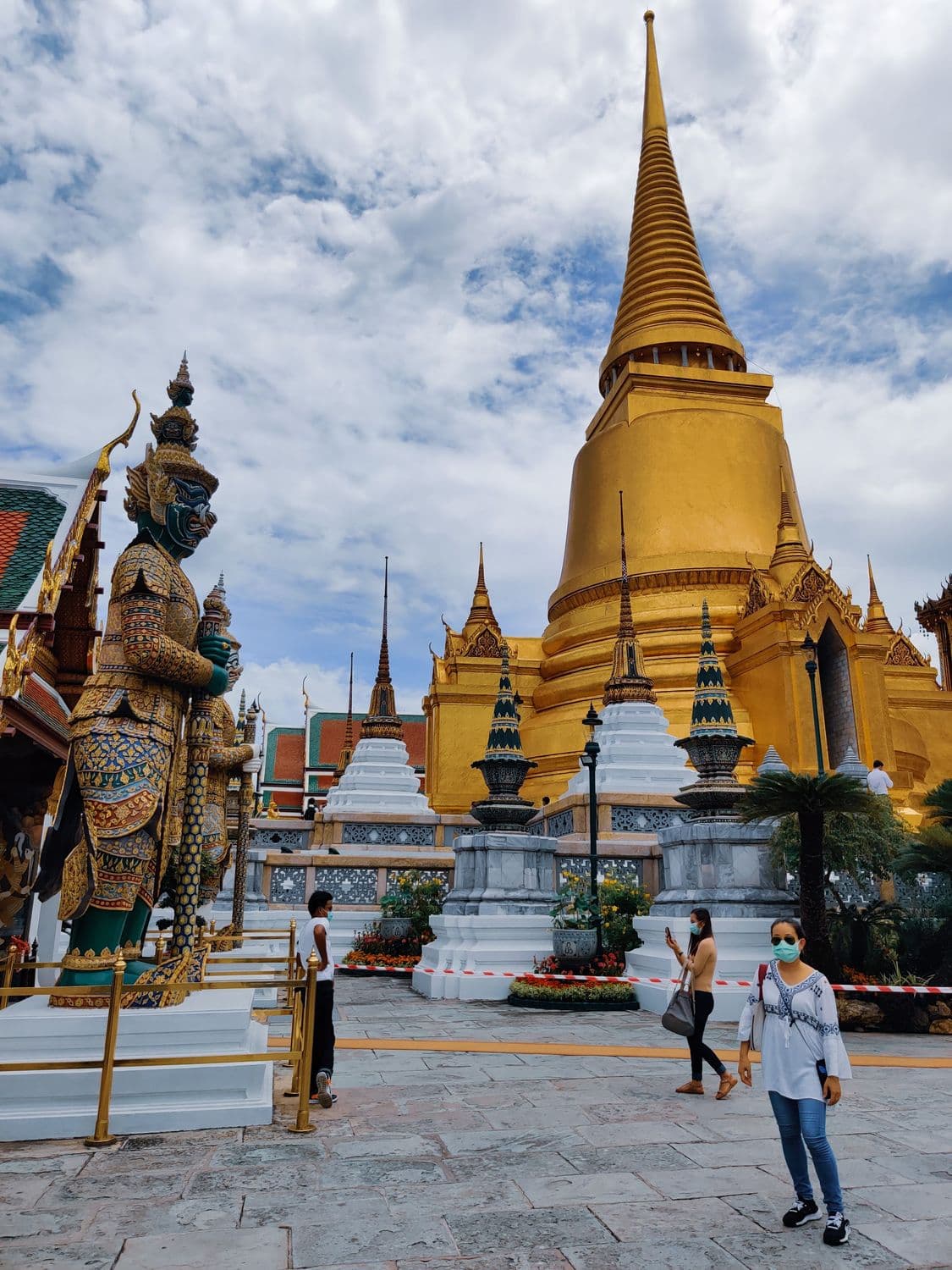
The Emerald Buddha sits in the main hall of the temple, Wat Phra Kaew, in the walled compound guarded by giant demon statues. Inside, it sits high on a towering golden altar, small at that distance. This is a working place of worship, and people come here to pray.
Look up at the top of the altar. The gold is the season's dress, and the green of the face is the stone.
The Trevlo tour of the Grand Palace tells the statue's journey outside its temple, then takes you inside, at the fourth and fifth stops. It begins at the visitors' gate, passes the painted Ramakien gallery and the model of Angkor Wat, and ends at the Chakri Maha Prasat, the throne hall Thai people call a Westerner wearing a Thai crown. Six stops, about fifteen minutes of listening, at your own pace.
The first stop is free to play on this page, and your first tour in the app is free.