Stories · Rome
What does the Arch of Titus depict?
The Arch of Titus in the Roman Forum shows Rome's triumph over Jerusalem: soldiers carry off the Temple's menorah, and Titus rides in his chariot.
3 min read

Stories · Rome
The Arch of Titus in the Roman Forum shows Rome's triumph over Jerusalem: soldiers carry off the Temple's menorah, and Titus rides in his chariot.
3 min read
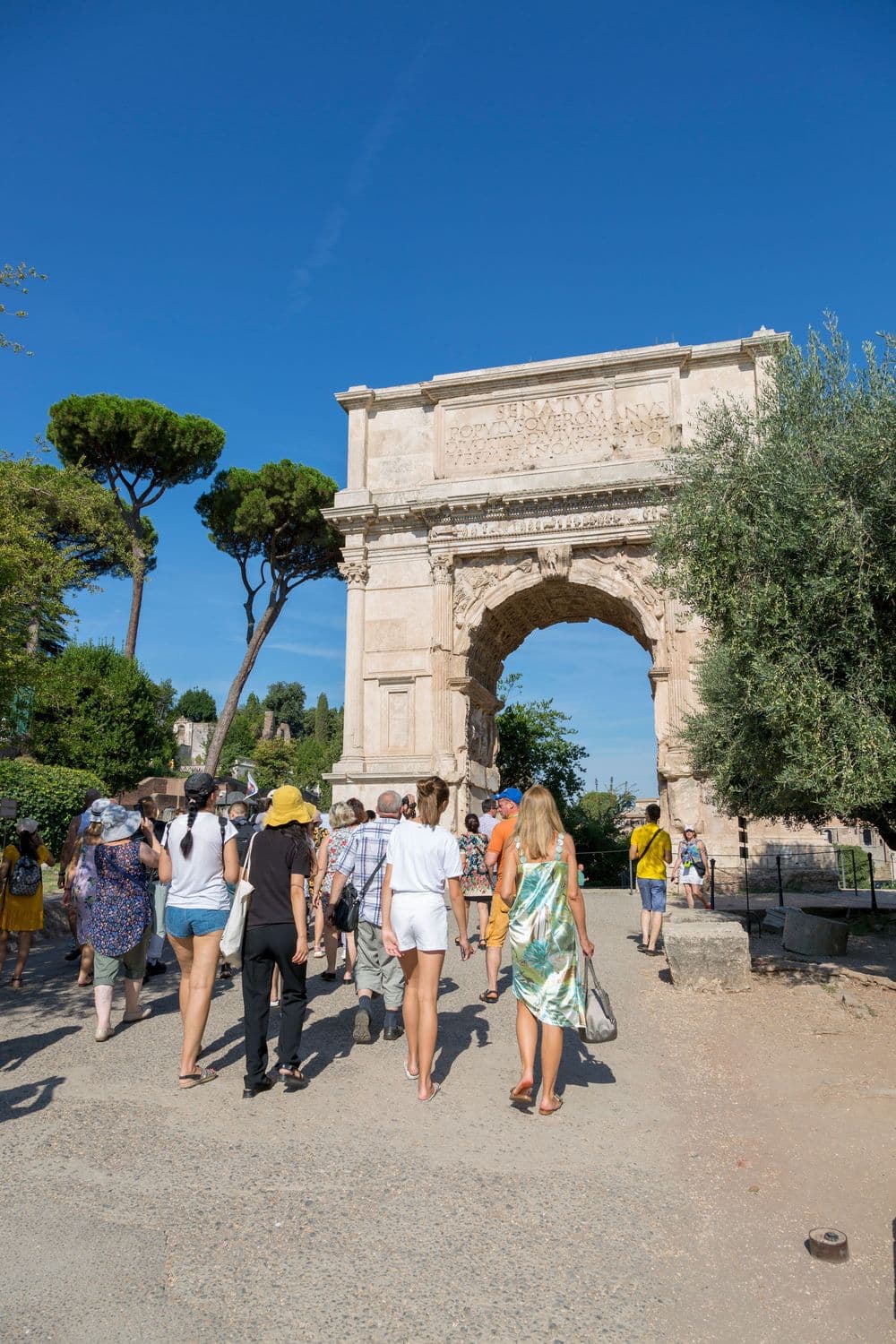
The emperor Domitian put the arch up soon after his older brother Titus died in AD 81. Two carved panels face each other inside its passage. One shows treasures from the Temple in Jerusalem carried in a victory parade. The other shows Titus in his chariot, crowned by the goddess Victory. In the vault overhead, an eagle carries him up to join the gods.
In AD 66 the province of Judaea rose against Roman rule. The general Vespasian, Titus's father, was sent to crush the revolt. When he became emperor in 69, he left Titus to finish the war.
In AD 70, after a siege of several months, Titus's army took Jerusalem, and the Temple burned. The next year father and son rode through Rome in a triumph, the parade a victorious general was granted.
A Jewish commander who had gone over to the Romans, Josephus, watched it. He wrote that the golden table and the golden lampstand from the Temple were carried in the procession, among a vast quantity of other loot.
On the spoils panel, soldiers in laurel wreaths carry the seven-branched lampstand, the menorah, on poles across their shoulders. Others carry the table for the holy bread and a pair of long trumpets. They are heading for an archway.
On the panel opposite, Titus stands in a chariot drawn by four horses. Victory holds a wreath over his head.
The inscription on the side facing the Colosseum calls him "Divus Titus", the deified Titus. That one word shows the arch went up after his death, when the Senate had declared him a god.
The marble was once painted. In 2012 a team from Yeshiva University in New York found traces of yellow ochre on the menorah. It had been coloured gold.
Vespasian put the menorah on show in Rome, in his new Temple of Peace. After that the trail fades. Many historians think the Vandals took it when they looted Rome in 455. Procopius, a Byzantine historian, says a general brought the Temple treasures from Carthage to Constantinople about eighty years later. He adds that the emperor Justinian sent them on to Jerusalem. No record shows they arrived.
The arch had its own adventures. In the Middle Ages a powerful Roman family, the Frangipane, built it into their fortress. In the 1820s the architect Giuseppe Valadier restored it, rebuilding the missing outer parts in travertine, a plainer stone, so that anyone could tell new from old.
Rome's Jews long kept a custom of not walking under it. In December 1947, days after the United Nations voted to create a Jewish state, Jews in Rome marched through the arch the opposite way from the old triumph. The menorah on this relief became the model for the emblem of the State of Israel.
Stand at the arch on the Via Sacra, the ancient paved road through the Forum, facing its passage. The original marble is in the middle, between Valadier's travertine. Look for the menorah, tilted on the soldiers' shoulders, on one of the inner walls.
The Trevlo tour of the Roman Forum tells this story at the Arch of Titus, its third stop. It starts at an overlook on the Capitoline Hill and walks the Via Sacra. After the arch come the Temple of Castor and Pollux, the Basilica Julia and the Temple of Saturn. Six stops, about twenty-nine minutes of listening, at your own pace.
The first stop is free to play on this page, and your first tour in the app is free.