Stories · Rome
What does Trastevere mean?
Trastevere means across the Tiber, from the Latin trans Tiberim. The Rome neighbourhood lies on the river's west bank, opposite the ancient city.
3 min read

Stories · Rome
Trastevere means across the Tiber, from the Latin trans Tiberim. The Rome neighbourhood lies on the river's west bank, opposite the ancient city.
3 min read
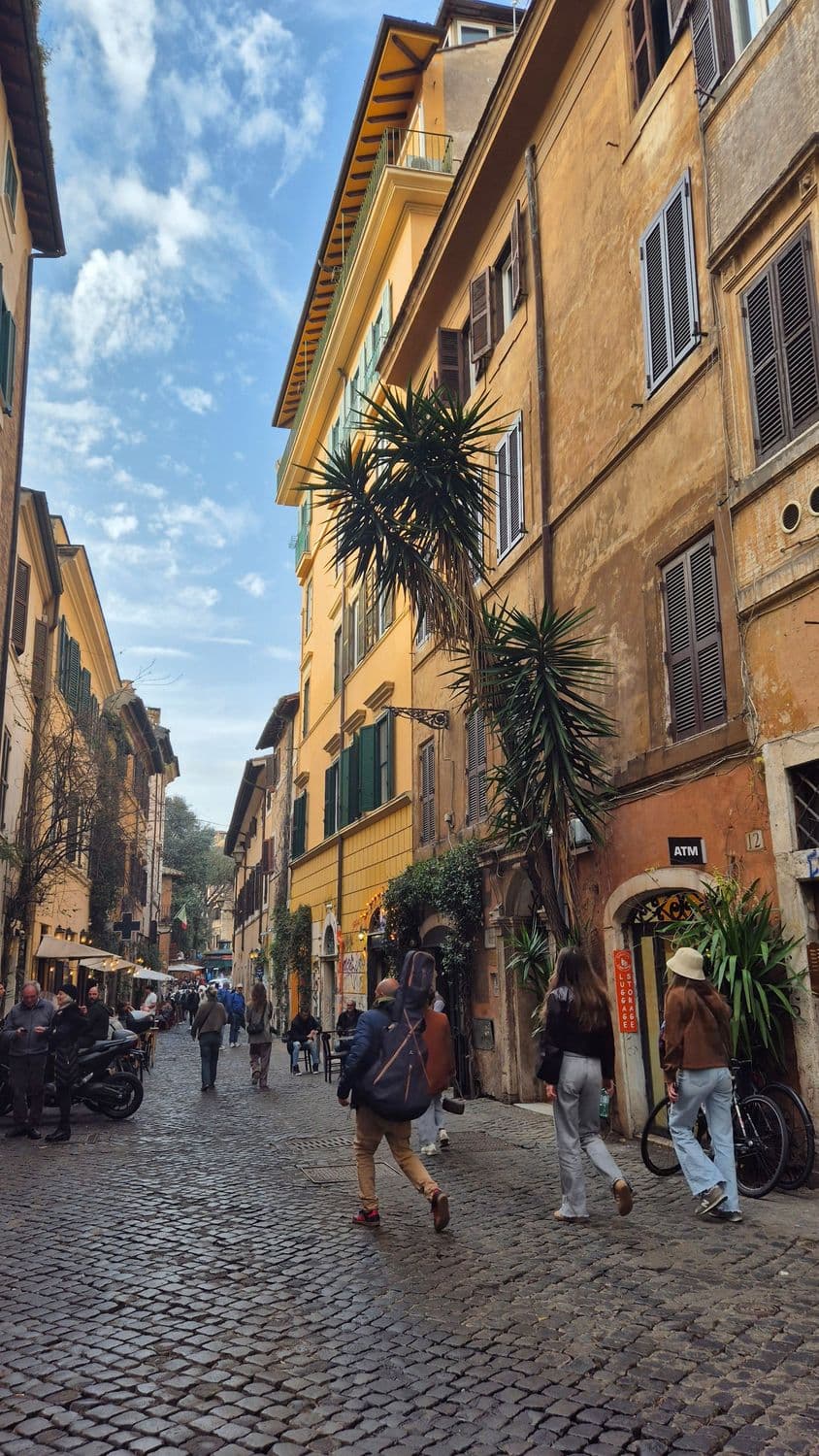
In 7 BC the first emperor, Augustus, divided Rome into fourteen regions. The fourteenth lay on the west bank of the river, and he called it Trans Tiberim. Over the centuries the Latin wore down into Italian, and the name stuck. Today Trastevere is one of Rome's historic districts, and the people born there still call themselves Trasteverini.
In Rome's earliest days, the land across the river belonged to its northern neighbours, the Etruscans. Later it filled with sailors, fishermen and boatmen who worked the river harbour, and with newcomers from the eastern Mediterranean.
Augustus's fourteenth region was huge. It took in the Janiculum, the long hill behind Trastevere, and even the Vatican Hill to the north. So, strictly speaking, the Vatican began life as part of "across the Tiber" too.
Many of the newcomers were Jews. In AD 40 Philo, a Jewish scholar from Alexandria in Egypt, came to Rome to plead with the emperor Caligula. He wrote that the great section of the city on the other side of the Tiber was home to Jews. Most, he said, had been brought to Italy as captives, then freed, and were now Roman citizens.
The church of Santa Maria in Trastevere, on the neighbourhood's main square, is one of the oldest in Rome. Two old stories explain why it stands here.
The historian Cassius Dio records that in 38 BC olive oil spouted from the ground beside the Tiber. Christian writers from the fourth century on placed the spring on this spot, and read it as a sign that Christ was coming.
The second story comes from a Roman collection of emperors' lives, the Historia Augusta. Christians had taken over a piece of public land, and the keepers of an eating-house claimed it was theirs. The emperor Severus Alexander, who reigned from 222 to 235, sided with the Christians. It was better, he decided, for some sort of god to be worshipped there than for the place to go to the eating-house. The book doesn't say where the plot was. Tradition puts it here, where Pope Callixtus the First is said to have founded a church.
Pope Julius the First rebuilt it around 340. The church standing now went up in the 1140s, under Pope Innocent the Second, with 22 ancient granite columns reused inside.
Trasteverini are proud of their side of the river. Each July the neighbourhood holds the Festa de' Noantri; in 2026 it ran from 13 to 27 July. In the local dialect, noantri means "we others", the rest of us, as against the Romans from everywhere else. A cedarwood statue of the Virgin Mary, said to have been found by fishermen at the mouth of the Tiber in 1535, is carried through the streets and along the river by boat.
Stand in Piazza di Santa Maria in Trastevere, between the fountain and the church, facing its front. Look up at the band of gold mosaic across the front. Mary sits in the middle, nursing the infant Jesus, with a line of women holding lamps on either side. Inside, near the main altar, a marble plaque reading Fons Olei, "spring of oil", marks where the oil is said to have flowed.
The Trevlo tour of Trastevere starts at this church and tells the story of the name there. It winds past a corner shrine, the bars of Via dei Genovesi, Santa Cecilia and the wide Viale di Trastevere, and ends at the market in Piazza di San Cosimato. Six stops, about thirty-two minutes of listening, at your own pace.
The first stop is free to play on this page, and your first tour in the app is free.