Stories · Rome
Why does the Pantheon have a hole in the roof?
The hole in the Pantheon's dome, the oculus, is the temple's only window. Leaving the top open let the sun in and took weight off the huge concrete dome.
3 min read

Stories · Rome
The hole in the Pantheon's dome, the oculus, is the temple's only window. Leaving the top open let the sun in and took weight off the huge concrete dome.
3 min read
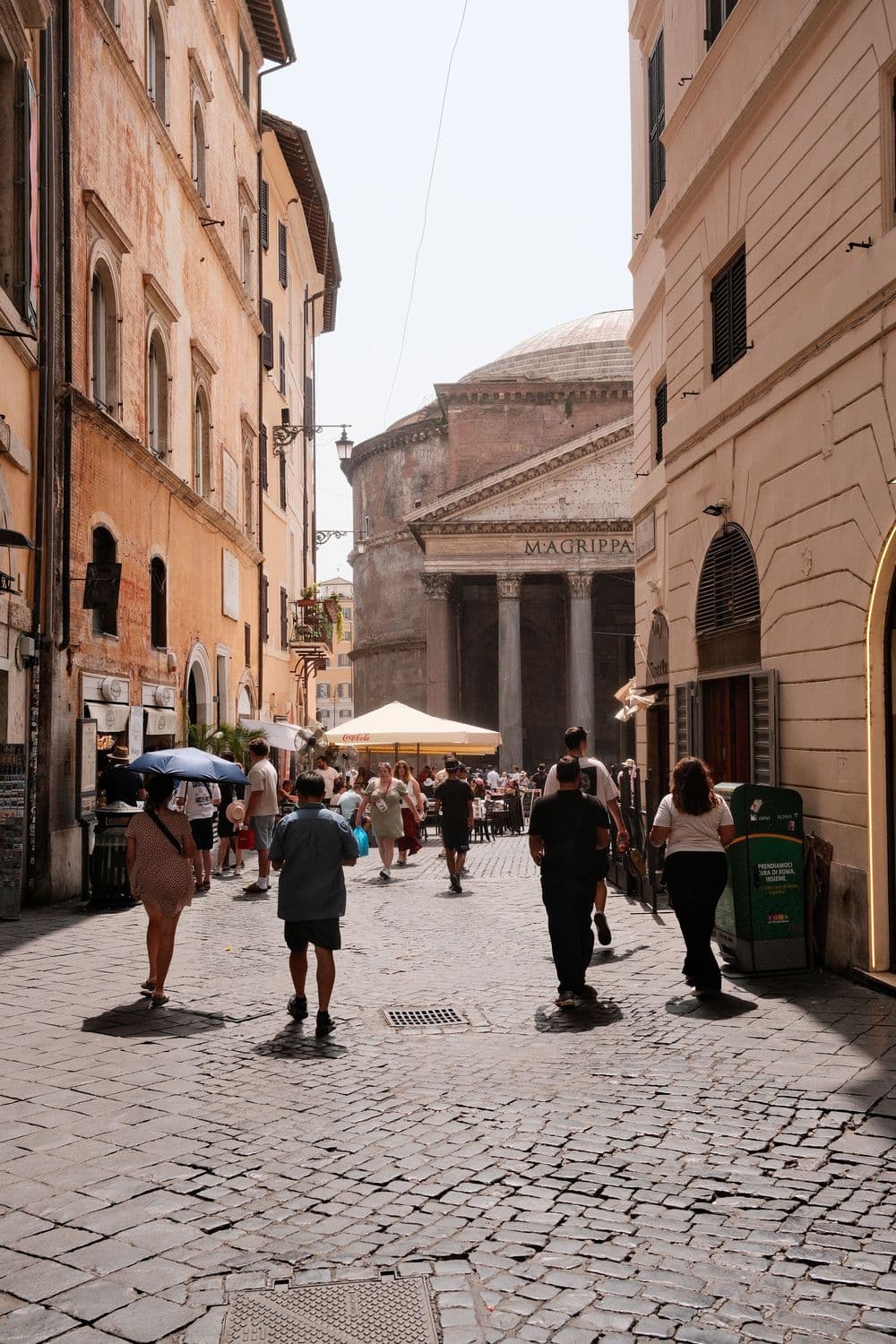
No Roman wrote down why, so the answer comes from the building itself. Builders working for the emperor Hadrian finished the dome around AD 126. It is 43 metres (142 feet) across, and at its top they left a round opening about 9 metres, close to 30 feet, wide. It has never had glass in it. When it rains in Rome, it rains inside the Pantheon.
Hadrian, the emperor who also built the wall across northern England, rebuilt the Pantheon after an earlier version burned. He left the original builder's name on the front: Marcus Agrippa, the right-hand man of the first emperor, Augustus.
Inside, he put no windows at all. The only daylight comes through the open bronze doors and the hole overhead, the oculus, Latin for "eye". On a sunny day a disc of light slides slowly around the curved ceiling and walls, like the shadow on a sundial.
About a century later the historian Cassius Dio guessed that the name Pantheon, "all the gods", came either from its many statues or from the way the dome resembles the heavens. In 2011 two researchers, Robert Hannah and Giulio Magli, argued that the sunlight was planned. At noon on 21 April, the day Romans celebrated their city's birthday, the beam falls on the entrance. It is a theory, and nobody knows what ceremonies were held here.
The dome is concrete with no steel inside. It is about 6 metres thick at the bottom and only about 1.2 metres around the oculus. The builders also mixed lighter stone, including volcanic pumice, into the concrete as it rose.
The top of a dome is the hardest part to hold up. By leaving it open, the builders removed that weight altogether and finished the dome with a ring around the opening. The rows of sunken squares in the ceiling, the coffers, take out more weight. Nearly 1,900 years on, it is still the largest unreinforced concrete dome in the world.
Rain falls straight onto the floor. The marble floor has a gentle slope, about 30 centimetres (a foot) in all, and small holes carry the water into drains underneath.
Romans also told a livelier story. An old legend says the hole was once closed by a giant bronze pine cone, until the day in 609 the Pantheon became a church. Demons fleeing the building knocked the cone off, and it landed in a square nearby, still called Piazza della Pigna. A real Roman bronze pine cone does exist. It was a fountain, and it now sits in a courtyard of the Vatican.
The hole still gets used. Each year at Pentecost, as of 2026, Rome's firefighters climb onto the roof and drop rose petals through it during Mass.
Walk to the centre of the floor, right under the open sky. Look down at the marble around you for the small holes that drain the rain. Overhead, the coffers shrink row by row toward the ring of sky.
The Trevlo tour of the Pantheon tells this story under the oculus, its third stop. It starts in Piazza della Rotonda, crosses the bronze doors and visits the tomb of Raphael, then ends back outside under the portico's columns. Five stops, about twenty-one minutes of listening, at your own pace.
The first stop is free to play on this page, and your first tour in the app is free.