Stories · Prague
Who built the Prague astronomical clock?
The clockmaker Mikuláš of Kadaň built it by 1410, probably to astronomer Jan Šindel's design. The legend of Master Hanuš, blinded for it, is wrong.
3 min read

Stories · Prague
The clockmaker Mikuláš of Kadaň built it by 1410, probably to astronomer Jan Šindel's design. The legend of Master Hanuš, blinded for it, is wrong.
3 min read
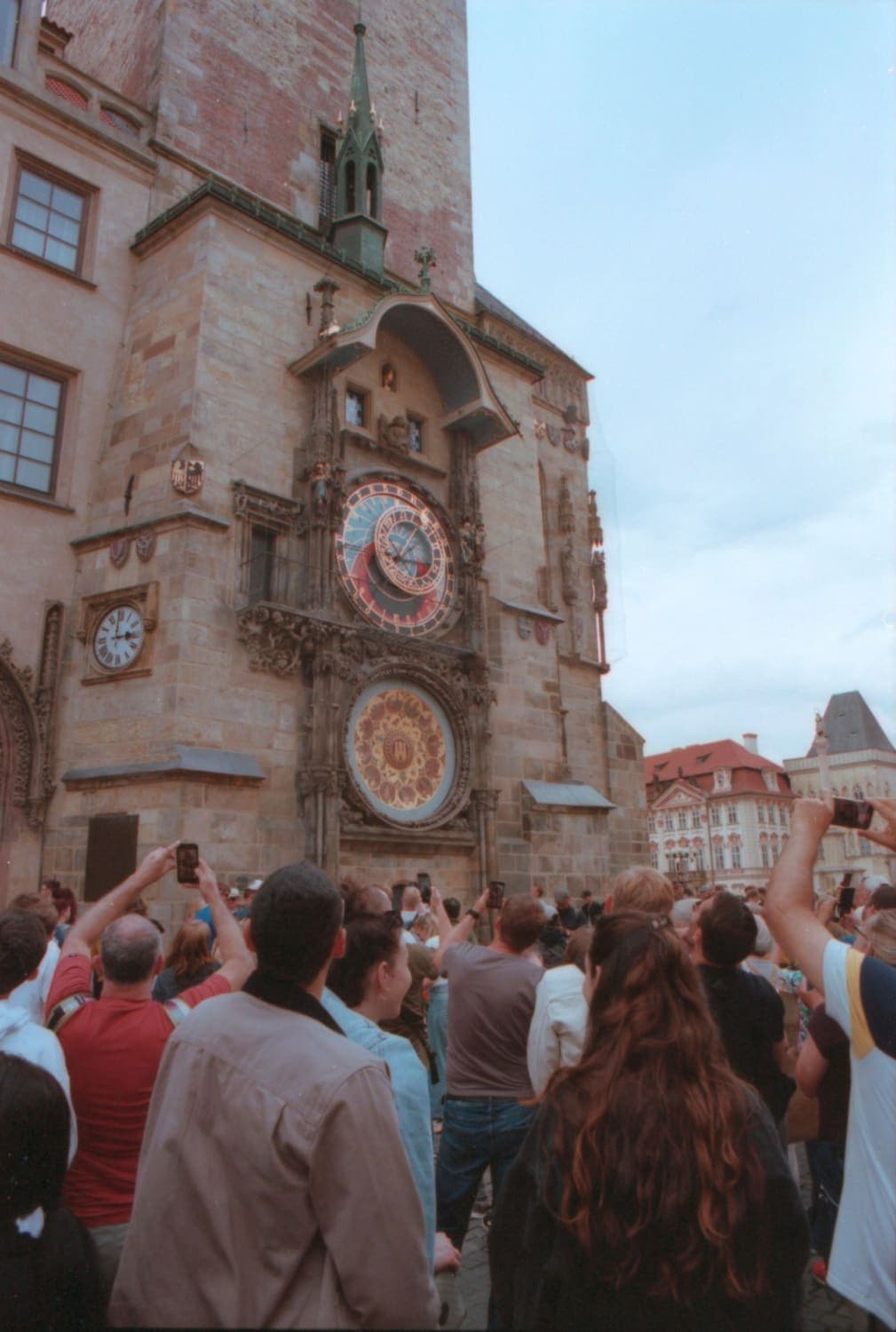
The Prague astronomical clock was built by Mikuláš of Kadaň, a clockmaker, probably to the design of Jan Šindel, an astronomer and professor at Prague's university. It is first recorded on 9 October 1410, when the council of Prague's Old Town thanked Mikuláš for his work and gave him a house and a yearly salary. For centuries the credit went instead to Master Hanuš, the clockmaker of a famous legend.
The story, best known from the Czech writer Alois Jirásek, says the councillors wanted no other town to own a clock like theirs. So they had its maker, Master Hanuš, blinded. In revenge he reached into the works and stopped the clock, and no one could make it run again for a hundred years.
Hanuš was a real man. His name was Jan Růže, and he was a clockmaker who worked on the clock decades after it was built. Over time the legend made him its builder, and guidebooks repeated it for hundreds of years.
The proof was a charter from 1410, in which the council described the clock and rewarded Mikuláš for it. The town book that held it burned with the Old Town Hall in May 1945. In 1962 a copy turned up in another book about the clock, and the historian of astronomy Zdeněk Horský set the record straight: the clock was Mikuláš's, and Hanuš had come later.
Jan Šindel's part was the astronomy. He was one of the university's leading scholars and served as its rector, and he probably worked out what the clock should show and how.
The oldest parts of the clock, its mechanism and the big astronomical dial, are the ones Mikuláš made. The dial is a picture of the sky as people saw it then, with the Earth fixed in the centre. A golden sun on a long hand travels across blue for day, a reddish band for dawn and dusk, and black for night. A ring of gold numbers round the edge counts the hours the old Czech way, from sunset. The moon is a little ball, half silver and half black, that turns to show its phase.
The famous figures came later. The apostles were added during repairs at the end of the 18th century, the rooster in the 1860s. On the hour, Death, a skeleton beside the dial, rings his bell, the figures next to him shake their heads, the apostles pass two windows above, and the rooster crows.
Six centuries on, it is the oldest astronomical clock in the world that still works. Since a restoration in 2018 it has been driven by weights again, as it was before the Second World War.
The clock is on the south side of the Old Town Hall tower, on Old Town Square. Stand back from the tower, where you can take in the whole dial, and find the golden sun on its hand: that is Mikuláš's sky, still turning.
The Trevlo tour Old Town Square & the Astronomical Clock tells this story at its first stop, in front of the clock. It goes on to the twenty-seven crosses at the foot of the tower, the Jan Hus Memorial and its rival column, Týn Church and Tycho Brahe, the Powder Tower and the Estates Theatre, where Mozart's Don Giovanni opened. It ends on the open ground beside the tower, where the town hall burned in 1945. Seven stops, about eighteen minutes of listening, at your own pace.
The first stop is free to play on this page, and your first tour in the app is free.