Stories · Prague
Why did they change the Prague astronomical clock?
In 2018 restorers replaced the electric drive fitted after the 1945 fire with a copy of the clock's old weight-driven works, as it ran before the war.
3 min read

Stories · Prague
In 2018 restorers replaced the electric drive fitted after the 1945 fire with a copy of the clock's old weight-driven works, as it ran before the war.
3 min read
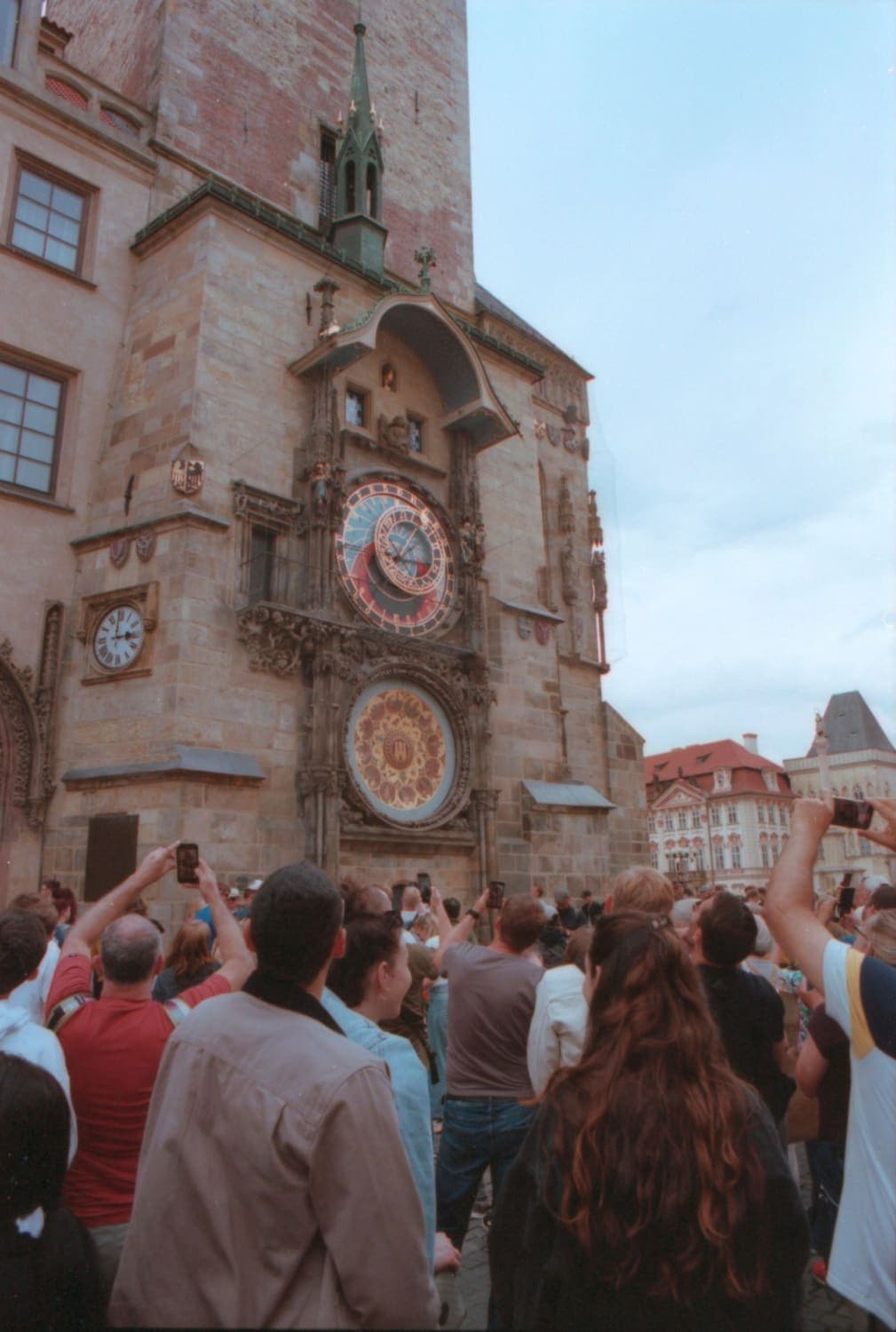
The Prague astronomical clock was changed in 2018 to bring back how it worked before the Second World War. After a fire in May 1945, it was repaired with an electric mechanism, which drove it for seventy years. In the 2018 restoration that motor was taken out and replaced with a reconstruction of the clock's nineteenth-century clockwork, driven by weights on ropes. The clock started again at six in the evening on 28 September 2018.
On 5 May 1945, as the war in Europe was ending, Prague rose against the German occupation. The Old Town Hall was one of the uprising's bases. On 8 May, hours before they signed their surrender, German troops fired on it. Its neo-Gothic wing burned down to its outer walls, and part of the city archive burned with it.
The clock's machinery survived, protected by its brick casing. Its wooden apostles, the twelve figures that pass its windows on the hour, did not.
The new apostles were carved by Vojtěch Sucharda, a sculptor, woodcarver and puppet maker who had founded his own puppet theatre in Prague. He chose not to copy the lost figures from photographs and carved his own. Clockmakers repaired the works, and in 1948 the clock ran again, now with an electric drive.
The burned wing was never rebuilt. Its ruins were cleared, and the space beside the tower is still open ground.
The clock was stopped in January 2018 for a full restoration. The restorers removed the 1948 electric mechanism and built a working reconstruction of the clockwork it had in the 1860s, with weights and stone counterweights. Small motors hidden in the winding drums now wind the weights back up, so the clock is driven the old way.
Taking the clock apart turned up a surprise. One apostle, Saint Thomas, was heavier than the rest, and an X-ray showed a metal case inside. In it was a long letter from Sucharda about his plans for the clock, which were never carried out, and the hard years after the war, as the Communists took power. It had waited about seventy years to be found.
The other change people noticed was the calendar dial below the clock. Its painting of the months is a copy of an 1866 design by the painter Josef Mánes, whose original is in the City of Prague Museum. A copy painted for the 2018 restoration changed many of Mánes's figures, and critics complained that some looked like the painter's friends. After a long row, the city commissioned a new, more faithful copy from the Academy of Fine Arts in Prague.
Walk round to the north side of the Old Town Hall tower, past the twenty-seven crosses in the paving, to the open ground where the burned wing stood. A stub of its wall still stands against the tower. Then go back round to the clock for the hour, when Sucharda's apostles come to the windows.
The Trevlo tour Old Town Square & the Astronomical Clock starts at the clock with the men who built it in 1410. It visits the twenty-seven crosses, the Jan Hus Memorial, Týn Church, the Powder Tower and the Estates Theatre, and tells this story at its seventh and last stop, beside the tower. Seven stops, about eighteen minutes of listening, at your own pace.
The first stop is free to play on this page, and your first tour in the app is free.