Stories · Prague
Why are the statues on Charles Bridge black?
Most are soft sandstone, darkened by age and a crust of soot and dirt from the air. The pale ones are copies; many originals are now kept indoors.
3 min read

Stories · Prague
Most are soft sandstone, darkened by age and a crust of soot and dirt from the air. The pale ones are copies; many originals are now kept indoors.
3 min read
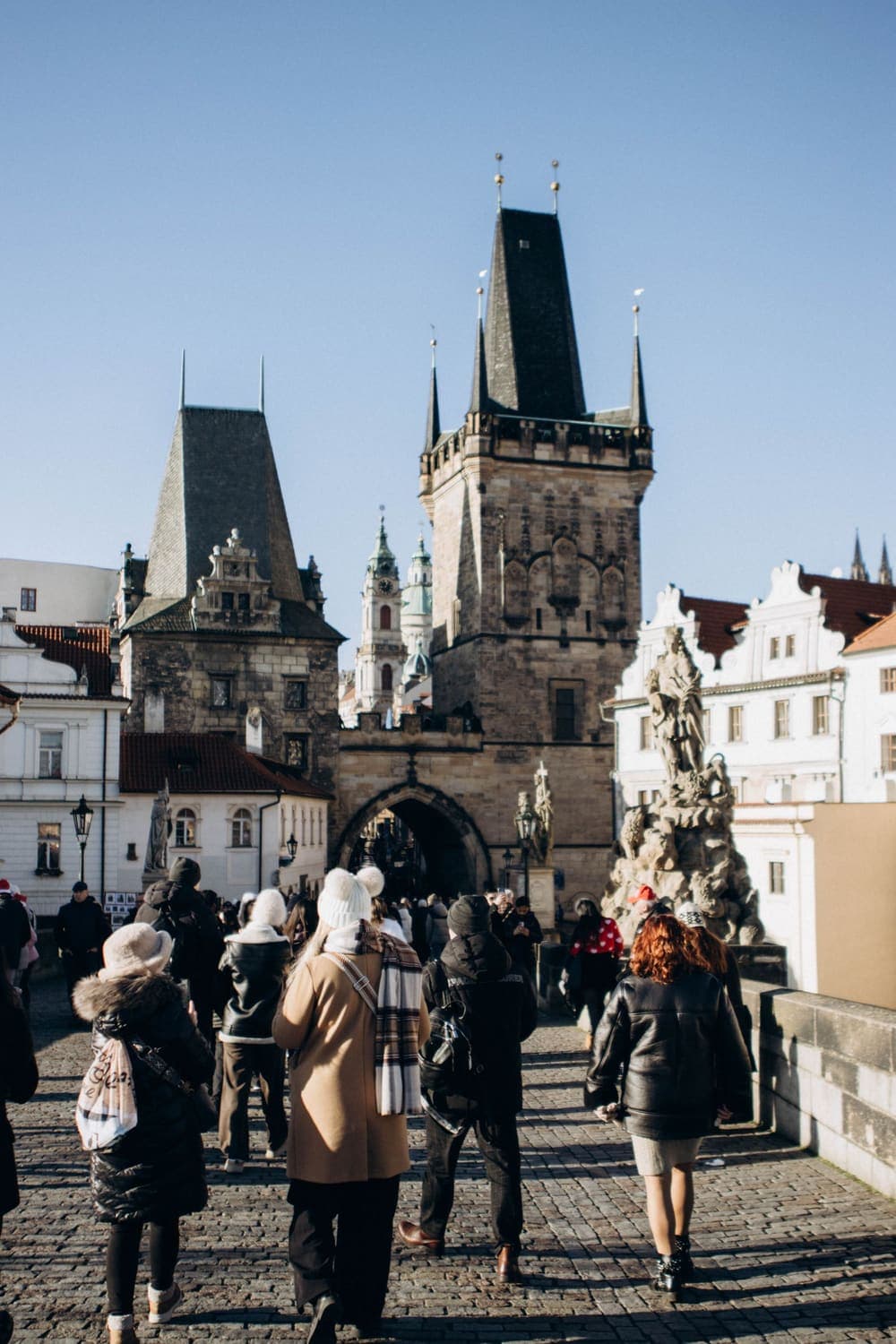
The statues on Charles Bridge are black because most of them are carved from sandstone, a soft stone that darkens as it weathers. Over the centuries it forms a dark patina, and soot and dirt from the city's air settle on it and harden into a black crust. That's also why they don't match: since the early twentieth century, worn statues have been replaced by copies, which start out pale, and many originals now stand indoors.
For its first three centuries the bridge had few statues: a cross near the Old Town end, and carvings on the towers. The first saint arrived in 1683, a bronze John of Nepomuk. Most of the rest went up in a rush between 1707 and 1714, paid for by religious orders, noblemen and the faculties of the university. Each donor chose a saint and a sculptor. The best of them were Matthias Bernard Braun and Ferdinand Maxmilián Brokoff.
They carved in local sandstone, which is easy to work. Outdoors it lasts about three hundred years. Restorers who survey the statues describe a black patina from fumes and smoke, layers of settled dirt turning into a crust, and dust and bird droppings in the folds of the robes. Only Nepomuk and the crucifix are bronze, and one saint is marble. All the rest are sandstone.
One statue shows what can happen to them. In 1711 Brokoff, aged twenty-three, carved Saint Francis Xavier baptising an Indian prince. The boy holding a book beside the saint is usually taken to be the young sculptor himself.
At half past five on the morning of 4 September 1890, timber from broken log rafts jammed against the bridge's piers in a flood. Two arches collapsed, and a third went a few hours later. Francis Xavier fell into the Vltava with Brokoff's Ignatius of Loyola, which stood opposite.
The pieces stayed in the river until 1906. The sculptor Čeněk Vosmík pieced Francis Xavier back together. After a long argument about whether to put the battered original back, he carved a copy instead, set up in 1913. Ignatius was replaced with a new group, Saints Cyril and Methodius.
Some statues were replaced in the mid-nineteenth century with new ones in the taste of the time. Since the early twentieth century, the rule has been copies of the originals. The originals are kept in the National Museum's Lapidarium, at the Výstaviště exhibition grounds, and in the Gorlice hall inside the walls of Vyšehrad. About a third of the statues on the bridge are still Baroque originals.
Stand on the bridge in front of Saint Francis Xavier, the fifth statue on the south side counting from the Old Town end, carried on the shoulders of four figures. It's Vosmík's paler 1913 copy. Look along the bridge from there and you can pick out blackened older statues next to paler copies.
The Trevlo tour Charles Bridge & Lesser Town tells this story at stop 3. It starts at the Old Town Bridge Tower, where Charles IV laid the first stone, and stops at the bronze crucifix where students held the bridge against the Swedes in 1648. After Francis Xavier it reaches Saint John of Nepomuk, goes down to Museum Kampa and the Lennon Wall, and ends at St Nicholas Church in the Lesser Town Square. Seven stops, about eighteen minutes of listening, at your own pace.
The first stop is free to play on this page, and your first tour in the app is free.