Stories · Rome
Who is buried in the Pantheon?
The painter Raphael, who chose it for his grave, and Italy's first two kings, Victor Emmanuel II and Umberto I, with Queen Margherita, among others.
3 min read

Stories · Rome
The painter Raphael, who chose it for his grave, and Italy's first two kings, Victor Emmanuel II and Umberto I, with Queen Margherita, among others.
3 min read
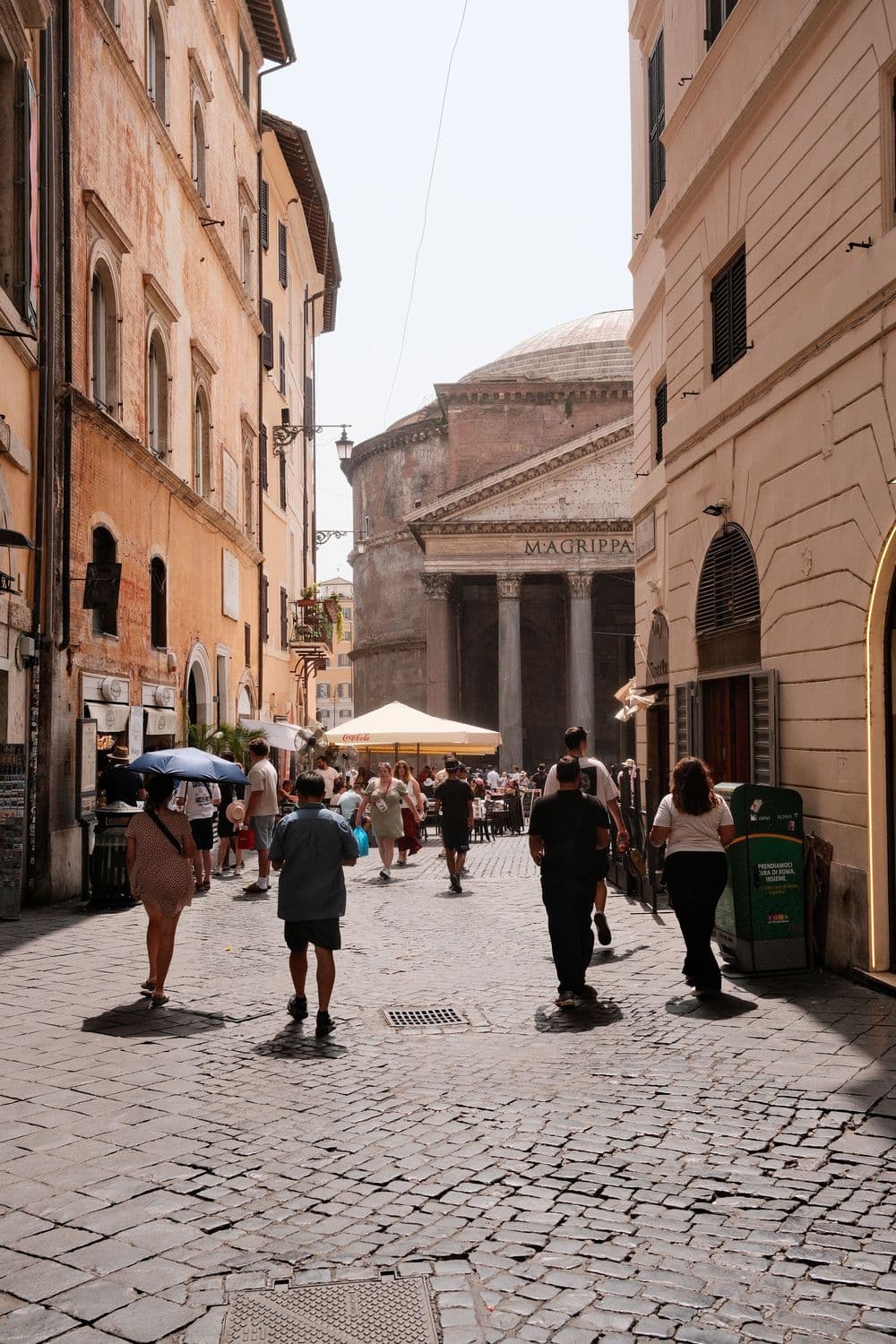
Raphael is buried in the Pantheon, in a grave the painter chose for himself before he died in 1520. Italy's first two kings lie there too: Victor Emmanuel II, who died in 1878, and his son Umberto I, with Queen Margherita at his side. Near Raphael rest Maria Bibbiena, his fiancée, who died before the wedding, the painter Annibale Carracci and the architect Baldassare Peruzzi, and the composer Arcangelo Corelli is buried here too. A Roman temple to the gods of Augustus's family, a church since 609, ended up holding painters and kings.
Raphael got there first. He died on Good Friday, 6 April 1520, at thirty-seven, and his will had already settled the question. It paid for one of the church's ancient shrines to be rebuilt, with an altar and a marble statue of Mary above it. Giorgio Vasari wrote it down in his lives of the artists:
he gave orders that some of his wealth should be used for restoring with new masonry one of the ancient tabernacles in S. Maria Ritonda, and for making an altar, with a marble statue of Our Lady, in that church, which he chose as his place of repose and burial after death
Lorenzetto carved that statue, and it still stands over the grave. She is known as the Madonna del Sasso, after the rock beneath her foot. Pietro Bembo supplied the epitaph, which claims that Nature was afraid of being outdone by Raphael while he lived, and afraid of dying herself once he was gone.
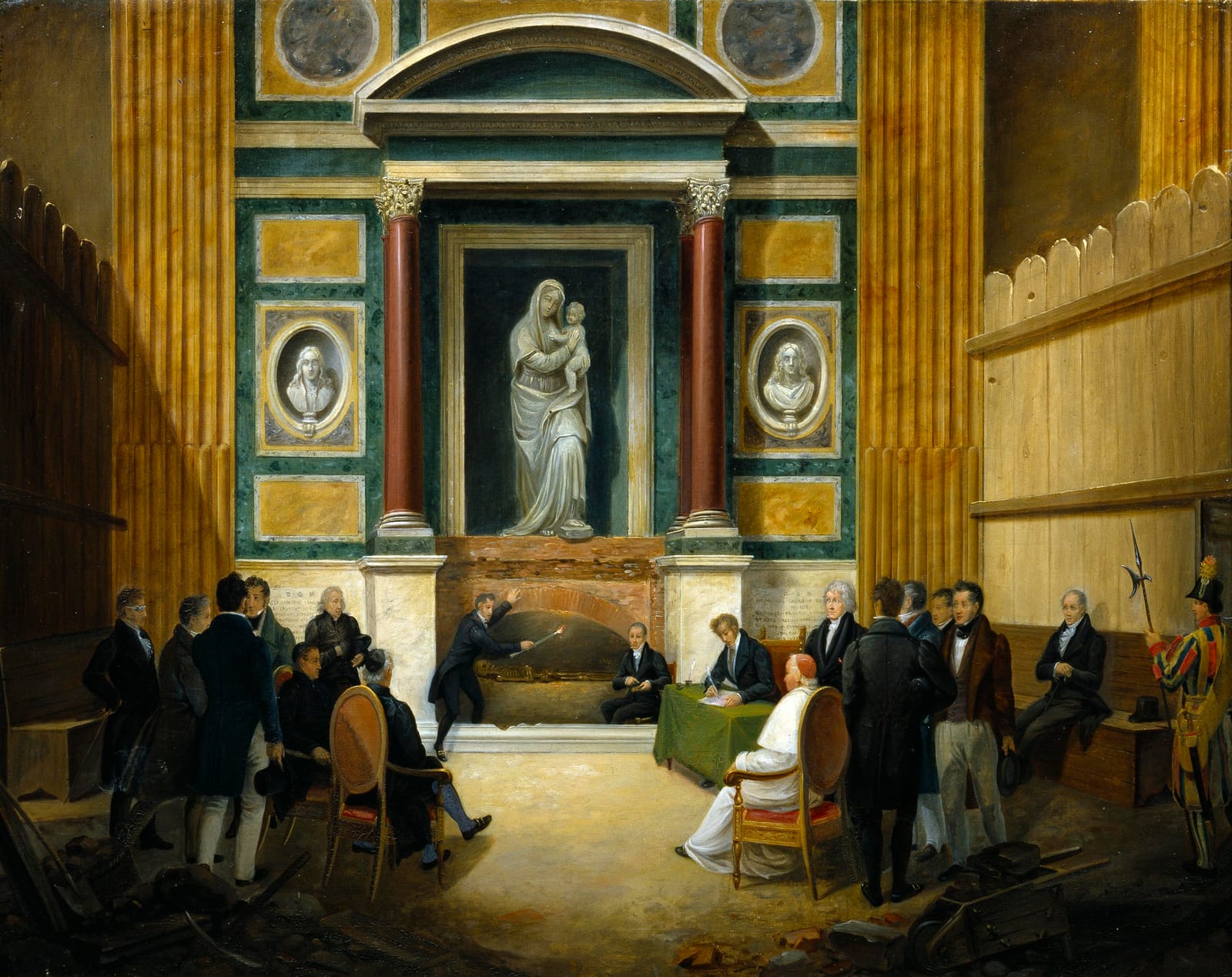
By the nineteenth century Raphael was close to a cult, and there was some uncertainty about whether he was in the tomb at all. On 14 September 1833 it was opened before 75 invited witnesses from the arts, the Church and the city, with doctors sitting as judges. The Danish sculptor Bertel Thorvaldsen was in the crowd. They found a fir chest, soaked through by Tiber floods, and inside it a skeleton the water had jumbled, which everyone present accepted as Raphael's. In October he went back in, sealed in lead within a first-century Roman sarcophagus that Pope Gregory XVI sent over from the Vatican's stores. The bust above it is by Giuseppe Fabris, who had started the search.
The kings arrived later. Victor Emmanuel II, first king of a united Italy, died on 9 January 1878. He had hoped to lie at the Basilica of Superga in Piedmont, but Rome's city council wanted him, and his son gave way. Eight days later some 250 veterans escorted his coffin from the Quirinal Palace, and the following day Umberto approved the founding of a guard of honour at the tomb. Volunteers still stand it. Umberto himself was assassinated at Monza in 1900 and laid opposite his father, and Margherita joined him in 1926.
From the bronze doors, follow the left-hand wall. Raphael is under the marble Mary with her foot on a rock, with his bust below and two plaques to the right, Bibbiena's above Carracci's. Umberto and Margherita are in the big chapel just before him. Across the room, under a Roman eagle, is Victor Emmanuel's bronze plaque: Padre della Patria, Father of the Fatherland.
Trevlo's Pantheon tour brings you to Raphael's shrine and the royal tombs by way of the porch a pope stripped of its bronze and the floor beneath the open eye. It has nine stops, about 21 minutes of listening, and it asks why this, of all ancient Rome's buildings, is still standing whole.
A free preview of the tour plays on this page, and your first tour in the app is free.