Stories · Rome
How did Michelangelo paint the Sistine Chapel ceiling?
Standing up, head bent back, on a wooden platform he designed himself. Michelangelo painted the Sistine Chapel ceiling in fresco from 1508 to 1512.
3 min read

Stories · Rome
Standing up, head bent back, on a wooden platform he designed himself. Michelangelo painted the Sistine Chapel ceiling in fresco from 1508 to 1512.
3 min read
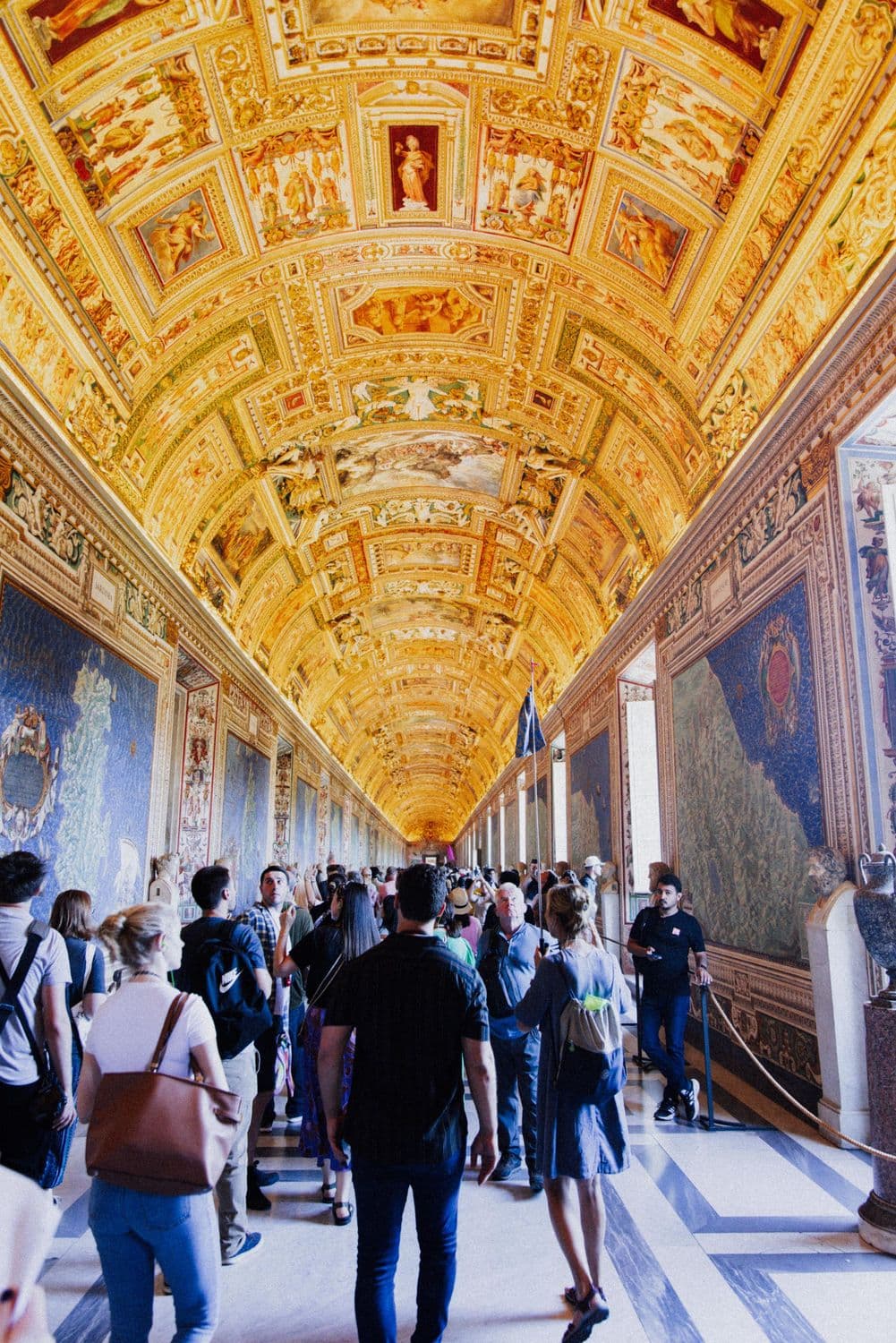
Michelangelo worked on a walkway that bridged the Sistine Chapel near the tops of its windows, about 20 metres, some 66 feet, up. Services carried on below him. Each day a fresh patch of plaster went on the vault, and he painted it before it dried.
Michelangelo was thirty-three and thought of himself as a sculptor. Pope Julius the Second wanted the chapel's ceiling painted anyway, and in May 1508 the contract was signed. The first plan was twelve apostles. Michelangelo called it a poor thing, and the pope let him design his own. It became nine scenes from the Book of Genesis and more than three hundred figures.
The first scaffold was built by Bramante, the pope's architect. It hung on ropes through holes pierced in the vault. Giorgio Vasari, the biographer who knew Michelangelo, says Michelangelo asked how the holes would be filled once the painting was done. Bramante said he would think about that afterwards.
Michelangelo had it replaced with his own design, a platform resting on supports in the walls, so nothing touched the surface he had to paint. Vasari adds a happy ending for the carpenter who rebuilt it. Michelangelo gave him the spare ropes, and he sold them to pay for his daughter's dowry.
Fresco means "fresh". Lime plaster is spread on the vault, and colour mixed with water is brushed into it while it is still wet. As the plaster dries, the colour is locked inside it. Painters work in patches called giornate, "a day's work", because whatever isn't painted by evening has to be cut away.
Then mould broke out on the early work, and Michelangelo asked to be let off the job. The pope sent Giuliano da Sangallo, an architect and old friend, who explained that Roman lime stayed wet too long, and how to clean it. Michelangelo kept going.
The popular picture has him lying on his back. He stood, with his head tipped back and his arm raised, for about four years.
He wrote about it, in a comic poem to a friend, Giovanni da Pistoia, around 1510. He says he has given himself a goitre from the strain. His beard points at heaven. Paint drips from his brush onto his face until it looks like a decorated floor, and he is bent like a Syrian bow. It ends with him saying he is not in a good place, and he is no painter. In the margin he drew himself, standing, reaching up to the vault.
Vasari says that for several months afterwards, Michelangelo could only read a letter by holding it up and tipping his head back.
Stand in the middle of the Sistine Chapel, under the ceiling. Look towards the end opposite the altar wall, at the scenes of Noah. Michelangelo started there, and the figures are small and crowded. When the scaffold came down halfway through, he could finally see his work from the floor. After that, his figures grow bigger and bolder.
The Trevlo tour of the Vatican Museums tells this story under the ceiling, at its fifth stop, after the bronze pinecone, the Laocoön, the Gallery of Maps and Raphael's School of Athens. Then it turns you to the altar wall, where Michelangelo painted a critic into hell. Six stops, about twelve minutes of listening, at your own pace.
The first stop is free to play on this page, and your first tour in the app is free.