Stories · Paris
How was the Mona Lisa stolen in 1911?
On 21 August 1911, a former Louvre workman, Vincenzo Peruggia, lifted the Mona Lisa off the wall while the museum was closed and walked out with it.
3 min read

Stories · Paris
On 21 August 1911, a former Louvre workman, Vincenzo Peruggia, lifted the Mona Lisa off the wall while the museum was closed and walked out with it.
3 min read
Peruggia was an Italian glazier who had worked at the Louvre fitting paintings with protective glass, by most accounts the Mona Lisa among them. Nobody noticed she was gone for more than a day. She stayed missing for over two years, hidden in a trunk in his room in Paris, until he tried to sell her in Florence.
On Mondays the Louvre was closed to the public. Peruggia said he came in at about seven that morning, through the workmen's door, in the white smock the staff wore. Older accounts have him hiding in a storeroom overnight.
The Mona Lisa then hung in the Salon Carré. He lifted her off the four iron hooks that held her. On a service staircase he took off the glass case and frame and left them. The painting itself is on a wooden panel, about 77 by 53 centimetres (30 by 21 inches). That's small enough to carry wrapped in cloth.
His way out was blocked by a locked door. Peruggia was taking the doorknob off when a plumber came along. Thinking he was a colleague, the plumber opened the door for him, and Peruggia walked out into the city.
Paintings were often taken away to be photographed, so the empty wall raised no alarm. On Tuesday morning a painter, Louis Béroud, arrived to work on a picture of the gallery and asked where the Mona Lisa was. Eventually the answer came back: nobody knew.
Théophile Homolle, the director of France's national museums, had reportedly once said you might as well try to steal the towers of Notre-Dame. He was forced to resign. The Louvre closed for days, and when it reopened, people queued to look at the bare wall. Police questioned the young Pablo Picasso, who turned out to have nothing to do with it.
Peruggia kept the painting in his room in a wooden trunk with a false bottom. In November 1913 he wrote to Alfredo Geri, an art dealer in Florence, signing himself "Leonardo V."
In December he took the trunk to Florence by train and checked into the Hotel Tripoli-Italia. Geri came to his room with Giovanni Poggi, the director of the city's Uffizi Gallery. Peruggia lifted out the false bottom, and there she was. The painting went to the Uffizi to be checked, and Peruggia was arrested.
Peruggia said he wanted her back in Italy, because Napoleon had stolen her. In fact Leonardo had taken her to France himself. A Florence court sentenced Peruggia to a year and fifteen days in prison, and he served about seven months.
After showings in Florence, Rome and Milan, she was back on the Louvre's wall on 4 January 1914.
The Mona Lisa is a short walk from the big red-walled gallery of French painting, following the museum's signs. She hangs on her own wall, behind glass.
Look at how small the panel is on that wall. It spent two years under the false bottom of a trunk.
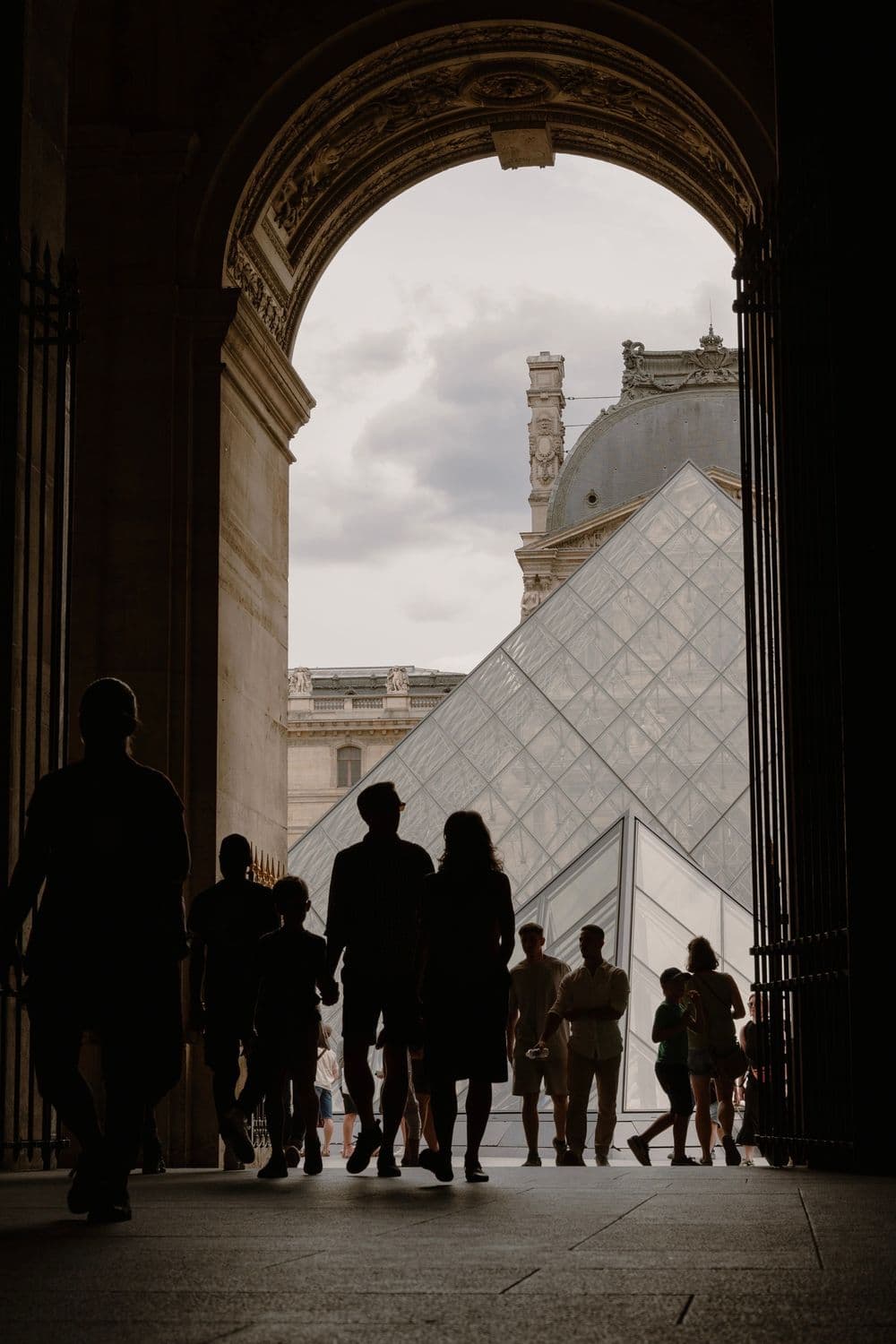
The Trevlo tour of the Louvre tells this story in front of the Mona Lisa. It starts under the glass pyramid. Then it visits the moat of the medieval castle, the Venus de Milo, the Winged Victory and the Raft of the Medusa. Six stops, about thirteen minutes of listening, at your own pace.
The first stop is free to play on this page, and your first tour in the app is free.