Stories · Paris
What was the Musée d'Orsay before it was a museum?
Before it was a museum, the Musée d'Orsay was the Gare d'Orsay, a Paris railway station and hotel built on the Seine for the World's Fair of 1900.
3 min read

Stories · Paris
Before it was a museum, the Musée d'Orsay was the Gare d'Orsay, a Paris railway station and hotel built on the Seine for the World's Fair of 1900.
3 min read
The Paris to Orléans railway company built it across the river from the Tuileries gardens, to a design by the architect Victor Laloux. Its trains ran to Orléans and the south-west of France. Within forty years the platforms were too short for main-line trains, and the building drifted for decades. It reopened in December 1986 as a museum of art from 1848 to 1914.
In May 1871, during the uprising known as the Paris Commune, fire gutted the Palais d'Orsay, a government building on this spot. Its blackened walls stood on the riverbank for 27 years.
In 1897 the railway company bought the site. It wanted a terminus in the heart of the city, ready for the World's Fair of 1900. Laloux hid a hall of iron and glass behind a stone front that matched the palaces along the Seine.
The trains were electric from the first day. It was the first electrified city terminus in the world, so no smoke blackened the glass roof. A hotel of 370 rooms came with it. The painter Édouard Detaille wrote in 1900: "The station is superb and looks like a Palais des Beaux-Arts", a palace of fine arts. Eighty-six years later, that is what it became.
By 1939, main-line trains had grown too long for Orsay's platforms, which had no room to stretch. Long-distance trains ended instead at the Gare d'Austerlitz, upriver, and Orsay was left with suburban services.
The building found other jobs. In the Second World War it was a depot for parcels to French prisoners of war. In 1945 it became a reception centre for prisoners coming home. The hotel stayed open, and in May 1958 General Charles de Gaulle held a press conference there, before about 500 journalists, as he prepared his return to power. He asked them why he would start a career as a dictator at 67.
In 1962 the director Orson Welles filmed The Trial in the empty station. The hotel closed in 1973. A theatre company led by the actors Jean-Louis Barrault and Madeleine Renaud then put up a big tent under the glass roof. From 1976 Paris's main auction house, Drouot, held its sales here while its own building was rebuilt.
Around 1970 permission was given to pull the station down and put up a large modern hotel. Jacques Duhamel, the minister of culture, ruled against the hotel. In 1973 the station went on France's list of protected historic buildings.
French museum officials proposed turning it into a museum for the art of the later nineteenth century, between the old masters in the Louvre and the modern art at the Pompidou Centre. The decision was made in 1977. The Italian architect Gae Aulenti designed the galleries inside, and President François Mitterrand opened the Musée d'Orsay on 1 December 1986.
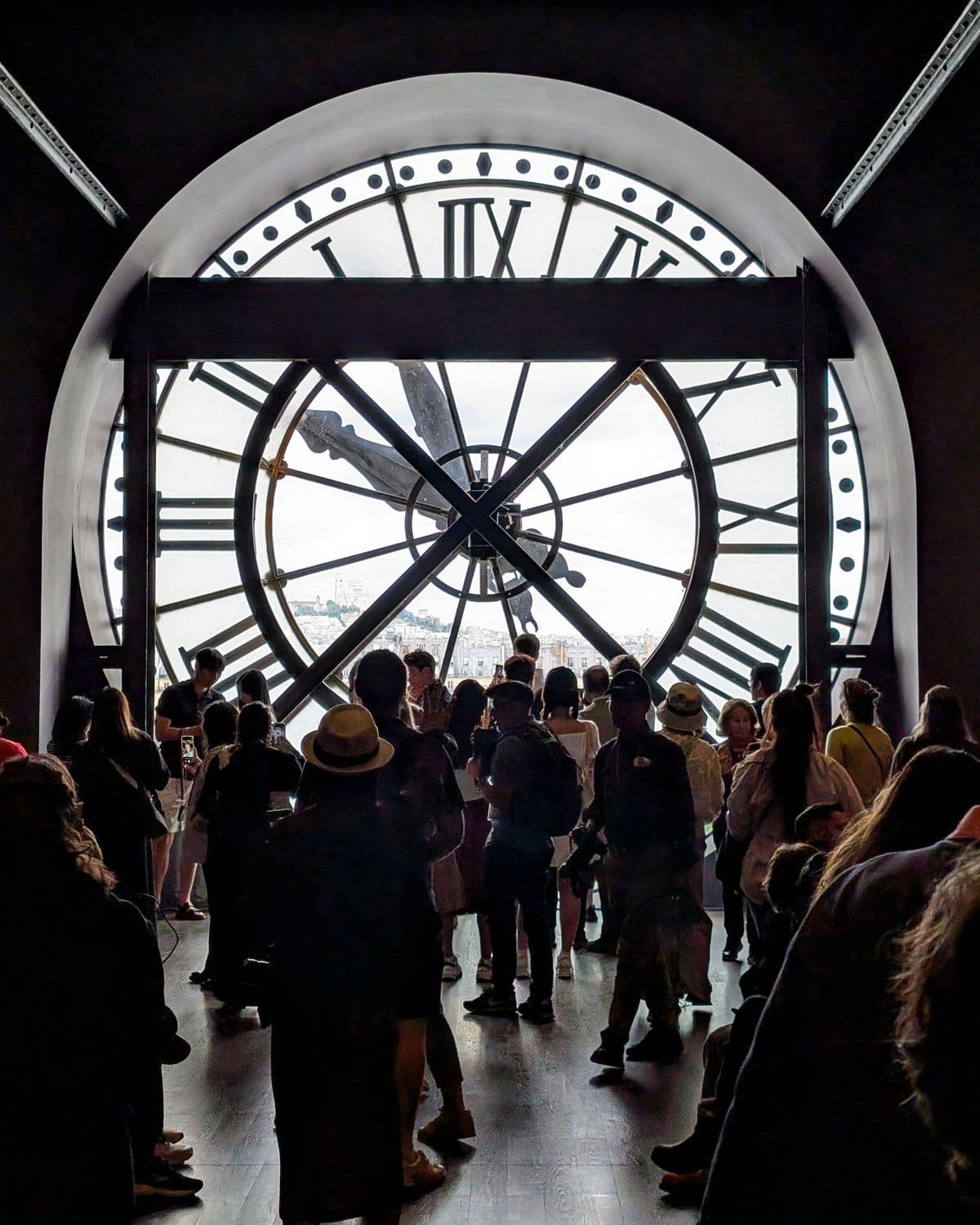
Walk into the long central hall under the glass roof. That is where the platforms were. Look up at the great gilded clock at the far end. It is the station's original clock, from the days of the trains.
The Trevlo tour of the Musée d'Orsay tells this story under the station clock, its first stop. It then visits Manet's Olympia, Monet's Rouen Cathedrals, Rodin's Walking Man and the Van Gogh gallery, and ends behind the glass face of a clock high above the Seine. Six stops, about twenty-eight minutes of listening, at your own pace.
The first stop is free to play on this page, and your first tour in the app is free.