Stories · Paris
Why was the Sainte-Chapelle built?
King Louis IX built the Sainte-Chapelle in the 1240s as a vast case of stone and glass for the Crown of Thorns, a relic he had just bought.
3 min read

Stories · Paris
King Louis IX built the Sainte-Chapelle in the 1240s as a vast case of stone and glass for the Crown of Thorns, a relic he had just bought.
3 min read
Louis IX of France, later Saint Louis, acquired the crown in 1239 from Baldwin II, the debt-ridden emperor of Constantinople. He paid 135,000 livres. The chapel he then built to hold it, inside his palace on the Île de la Cité, cost about 40,000, stained glass and all. It was consecrated on 26 April 1248.
Baldwin II ruled what was left of a crusader empire in Constantinople, and he was broke. He had pledged the Crown of Thorns, revered as the crown Jesus wore at the Crucifixion, to Venetian lenders as security for a large loan. After two years of negotiation, Louis paid off the debt and took the relic.
On 10 August 1239, Louis went out to meet it at Villeneuve-l'Archevêque, a town near Sens, south-east of Paris. There he took off his royal robes. Barefoot and in a plain tunic, he and his brother Robert carried it on their shoulders. On 19 August the crown reached Paris, and the king walked barefoot again as it entered the city.
Louis kept collecting. In 1241 he bought more relics of the Passion, including a fragment of what was believed to be the True Cross. They needed a home worthy of them, and close to the king.
Building began in the early 1240s and took about six years. The Sainte-Chapelle has two levels. The lower chapel served the people who worked in the palace. The upper chapel, for the king and his guests, held the relics.
That upper chapel is mostly glass. Fifteen windows, each about 15 metres (50 feet) tall, hold 1,113 panels of scenes from the Bible, and about two-thirds of the glass is original. Medieval churches kept relics in jewelled boxes called reliquaries. The Sainte-Chapelle is one of those boxes, made big enough to walk into.
The box, for all its glass, still cost less than a third of what went inside it.
The Revolution stripped the chapel. Its sculptures were smashed, its spire was pulled down, and for a time it served as a flour store. The crown survived. In 1806 it joined the treasury of Notre-Dame. Architects restored the chapel between 1840 and 1863.
In April 2019 firefighters and a chaplain carried the crown out of the burning cathedral. It returned to Notre-Dame on 13 December 2024. As of October 2026, it is kept there in a new reliquary, in a chapel behind the choir.
Pass the security check at the main gates of the Palais de Justice, the law courts on the Île de la Cité. The Sainte-Chapelle rises in the courtyard inside. Look at the tall windows of its upper level, set high above the small windows of the lower chapel. Behind that glass is the king's chapel, where the Crown of Thorns was kept for five and a half centuries.
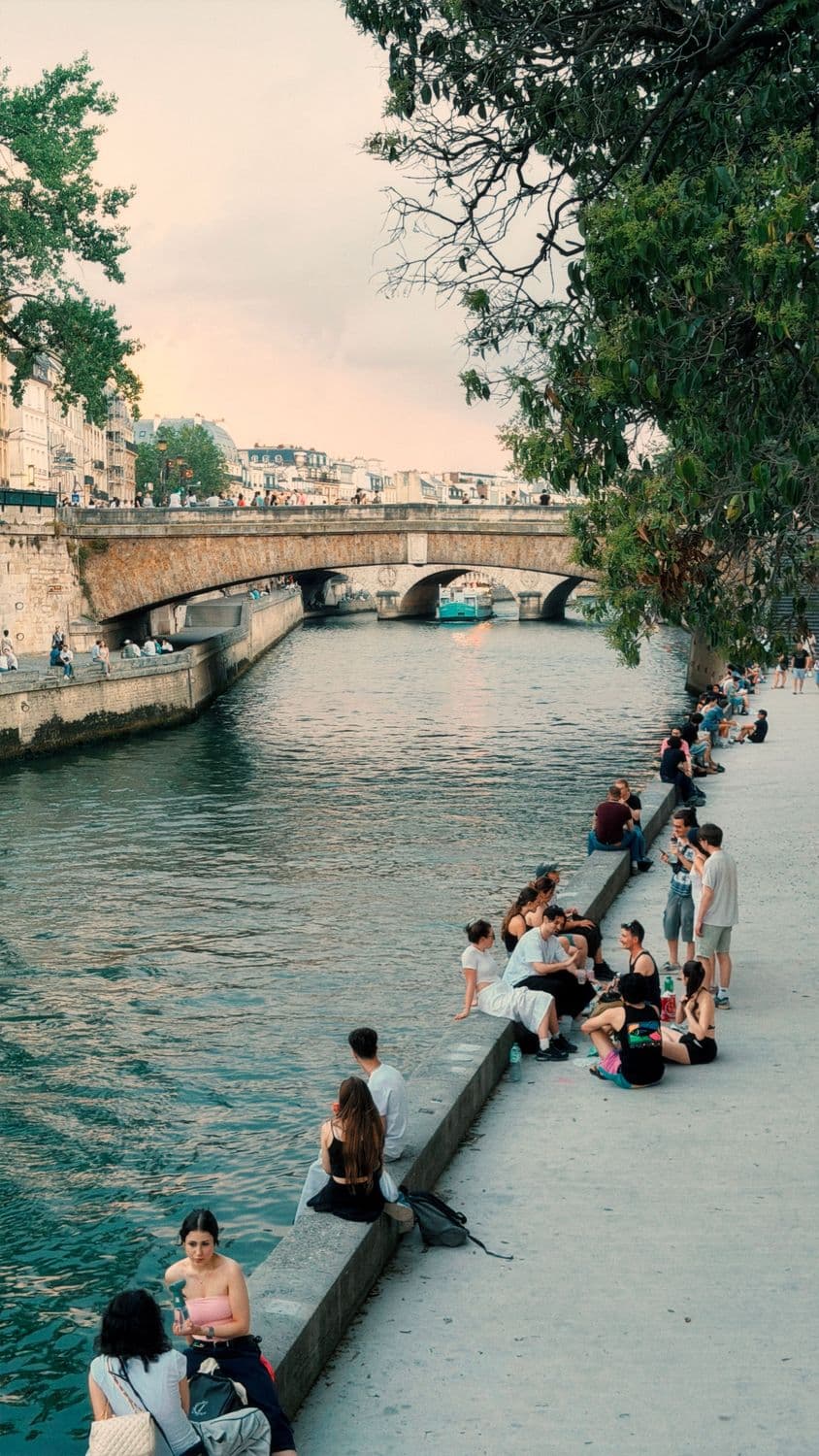
The Trevlo walk along the Seine tells this story at its third stop, the Sainte-Chapelle. It starts on the Pont Neuf and crosses to the island by the Pont au Change. After the chapel it goes on to the bronze star of Point Zéro in front of Notre-Dame and the booksellers' green stalls on the Left Bank. Five stops, about twenty-four minutes of listening, at your own pace.
The first stop is free to play on this page, and your first tour in the app is free.