Stories · Paris
What was saved from the Notre-Dame fire?
The Crown of Thorns, Saint Louis's tunic, the rose windows, the great organ and both towers all survived the 2019 fire at Notre-Dame in Paris.
3 min read

Stories · Paris
The Crown of Thorns, Saint Louis's tunic, the rose windows, the great organ and both towers all survived the 2019 fire at Notre-Dame in Paris.
3 min read
On the night of 15 April 2019, firefighters, police and the fire brigade's chaplain carried the relics out by hand while the roof and spire burned. Firefighters saved the two bell towers. Sixteen copper statues from the roof had been taken away four days before.
The fire started under the roof at about twenty past six in the evening, among oak beams some eight hundred years old. At about ten to eight the spire fell through the stone vault.
Father Jean-Marc Fournier, chaplain to the Paris fire brigade, went inside with the firefighters. The cathedral's most precious relic, a ring of rushes venerated as Christ's Crown of Thorns, was locked in a safe. Finding the code took time. Firefighters were forcing the safe open as Fournier arrived with the keys, and police officers carried the crown out.
Fournier went for the consecrated communion hosts, which Catholics believe are Christ himself. Before carrying them out, he later said, he used them to bless the burning cathedral.
Around him, firefighters, police and city workers passed treasures out in a human chain. One was a tunic said to have belonged to Saint Louis, the king who brought the Crown of Thorns to Paris in 1239.
More than four hundred firefighters fought the blaze. Their biggest fear was the north tower. If its wooden bell frame burned, the falling bells could bring the tower down. A small team went inside and held the fire back.
Both towers stood. The three great rose windows survived, and so did the great organ. The next morning, the rooster weathervane from the top of the spire turned up in the rubble, dented, with its relics still intact inside.
On a low roof over the sacristy, three hives of about 180,000 bees came through. Their beekeeper said the smoke had simply made them drowsy.
The luckiest escape came four days early. On 11 April, a crane lifted the sixteen copper statues of apostles and gospel symbols off the roof for cleaning. One of them, Saint Thomas, has the face of Eugène Viollet-le-Duc, who designed the spire in the 1850s.
France rebuilt the spire exactly as Viollet-le-Duc designed it, in oak. It rises 96 metres, about 315 feet, as tall as a thirty-storey building, with a new golden rooster on top.
Notre-Dame reopened on 7 December 2024. Six days later, the Crown of Thorns came back in procession from the Louvre, where it had been kept since the fire. In the summer of 2025, the sixteen statues went back up around the spire.
Inside, walk down the nave to the crossing, where the long central aisle meets the two arms of the cathedral. Look up at the vault above the crossing: its pale new stone was rebuilt after the spire smashed through it.
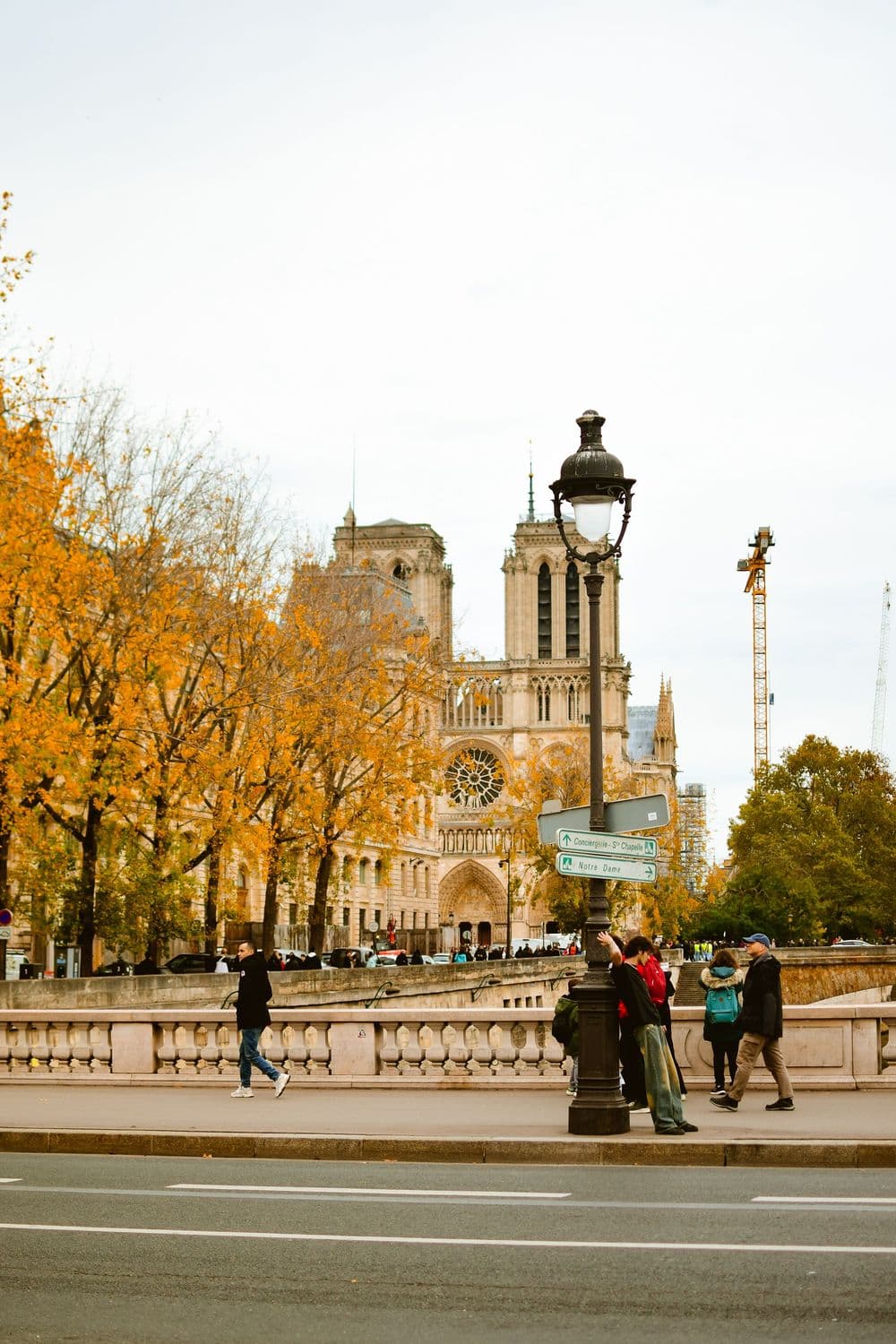
Outside, the Pont au Double, the small bridge beside the cathedral, faces its south side. From there you can see the new spire and the green statues stepping up the roof towards it.
The Trevlo tour of Notre-Dame tells this story at the crossing and ends on the Pont au Double, with the statues. On the way come stone kings beheaded in the Revolution, a saint carrying his own head and Victor Hugo with his clothes locked away. Five stops, about eleven minutes of listening, at your own pace.
The first stop is free to play on this page, and your first tour in the app is free.