Stories · Vienna
When was the Hofburg Palace in Vienna built?
Over six centuries. Its oldest part, a castle, dates from the 13th century; its newest wing was begun in 1881 and left unfinished in 1913.
2 min read

Stories · Vienna
Over six centuries. Its oldest part, a castle, dates from the 13th century; its newest wing was begun in 1881 and left unfinished in 1913.
2 min read
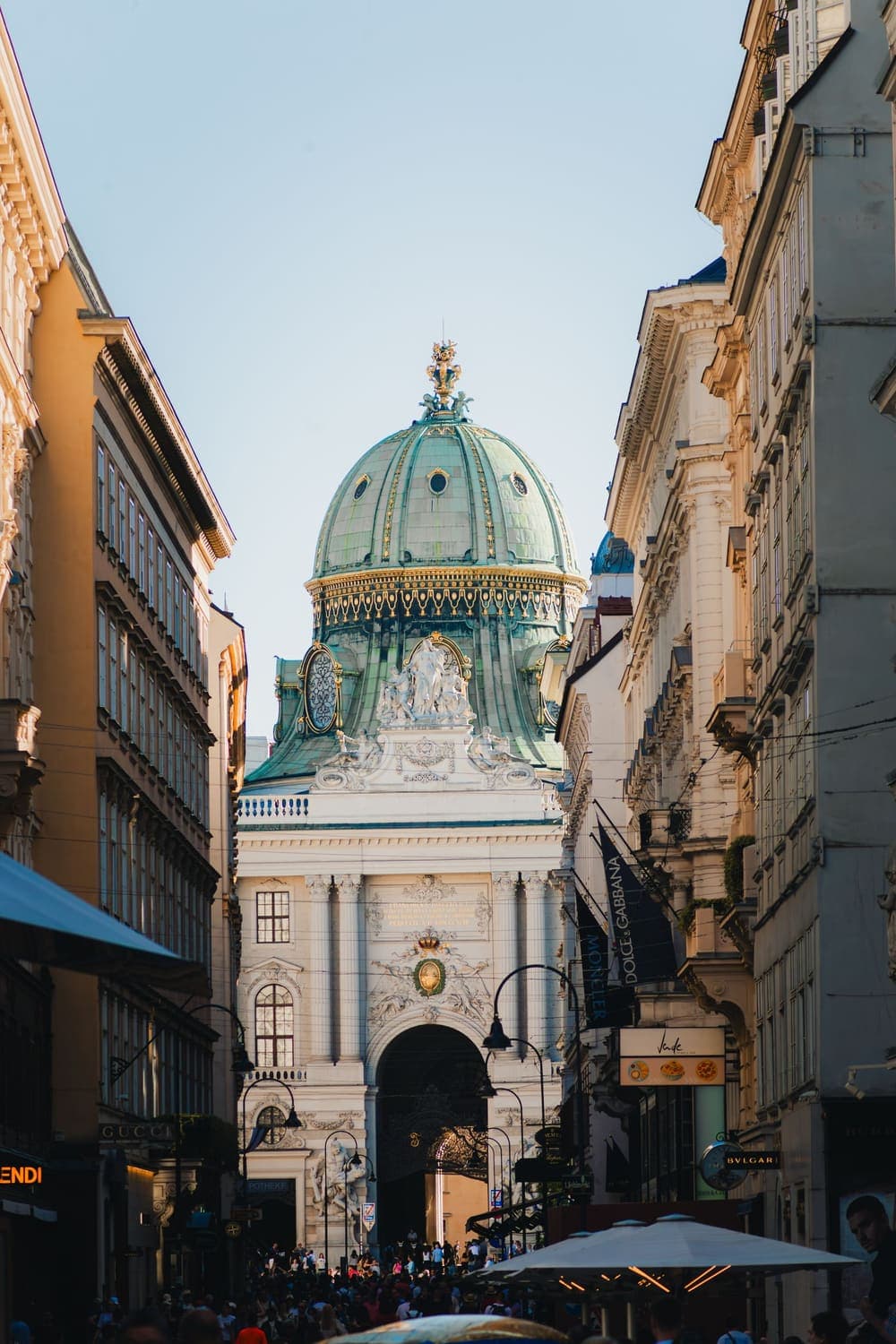
The Hofburg was never built all at once. Its oldest part is a square castle from the thirteenth century, finished by King Ottokar II of Bohemia in the 1270s. The Habsburgs took it from him and ruled from it until 1918, and almost every generation added something: a Renaissance gate in 1552, a riding hall in the 1730s, a domed gate in 1893. Its newest wing, the Neue Burg, was begun in 1881 and left unfinished in 1913.
The first Hofburg was a fortress on Vienna's wall, with towers at its four corners. Ottokar, who held Austria for a time, completed it in the 1270s. He lost Austria to Rudolf of Habsburg, and Rudolf's family made the castle their home.
It was simply called the Burg, the castle, until other buildings grew around it. Today it's the Swiss Wing, named after the Swiss guards who stood sentry there from 1745. In 1552 Ferdinand I gave it a new front door, the Swiss Gate, with a drawbridge over the moat and his titles in gold letters above the arch. The list names Rome, Germany, Hungary and Bohemia, and then gives up with "etc."
The Stallburg, now the stables of the Spanish Riding School, was built around 1558–1565 as a home for the future Maximilian II. The Amalienburg followed in 1582–1585. In the late 1600s Leopold I added the long Leopoldine Wing, where Maria Theresa later lived in winter.
Charles VI built the white Winter Riding School, finished in 1735, and ordered a grand curved front onto Michaelerplatz. He died before it was built. The old court theatre, the Burgtheater, stood in the way until 1888. Then Franz Joseph had the old design completed, and the Michaelertor, with its tall dome, opened in 1893.
Franz Joseph's last plan was the biggest. The architect Gottfried Semper designed an imperial forum: two great curved wings facing each other across Heldenplatz, linked by gates to the museums across the Ring. The Neue Burg, the New Palace, was begun in 1881. Its twin was never started. Work stopped in 1913, and five years later the empire was gone.
The Hofburg is still in use. Austria's president has worked in the Leopoldine Wing since 1946, and the palace holds the national library, the Imperial Treasury, the Sisi Museum and the Spanish Riding School.
Stand in the inner courtyard, In der Burg, in front of the Swiss Gate. Behind it is the oldest part of the palace. The long wing to your right, when you face the gate, is Leopold I's, now the president's. The domed passage behind you leads out to Michaelerplatz.
The Trevlo tour Hofburg & the Old Town reaches the Swiss Gate at its fifth stop. It starts at the Plague Column on the Graben, passes Demel on Kohlmarkt, the Looshaus facing the Michaelertor and the Spanish Riding School's stables, and after the gate goes out to Heldenplatz and the unfinished Neue Burg. It ends at the Theseus Temple in the Volksgarten, laid out where Napoleon's army blew up the palace walls. Seven stops, about nineteen minutes of listening, at your own pace.
The first stop is free to play on this page, and your first tour in the app is free.