Stories · Vienna
Why is it called the Spanish Riding School?
It's named after the Spanish horses the Habsburg court prized for riding. The school, first recorded in Vienna in 1565, was never in Spain.
3 min read

Stories · Vienna
It's named after the Spanish horses the Habsburg court prized for riding. The school, first recorded in Vienna in 1565, was never in Spain.
3 min read
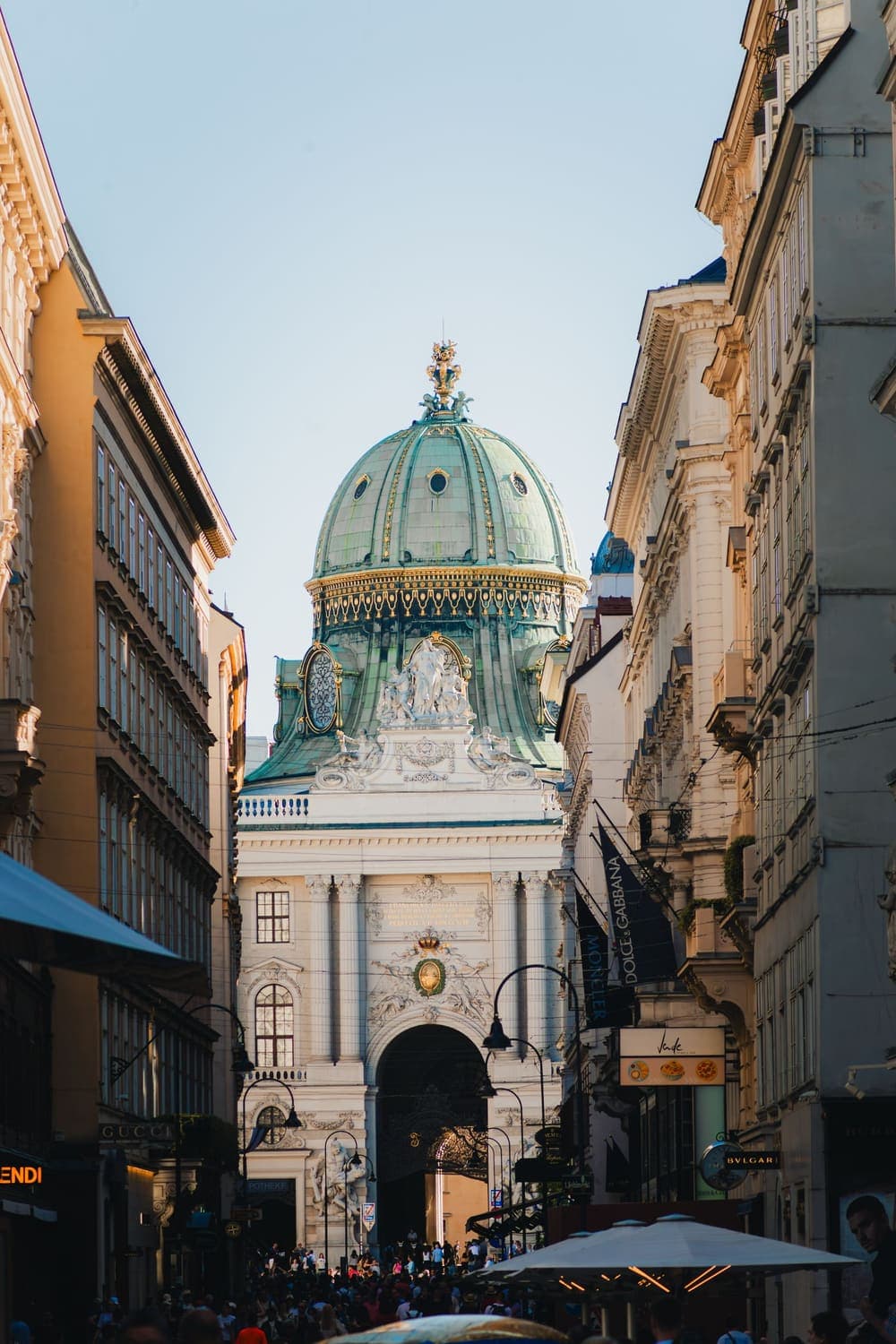
The Spanish Riding School is called Spanish because of its horses, not its home. It has always been in Vienna, inside the Hofburg, the palace of the Habsburg emperors. In the 1500s the Habsburg court prized horses from Spain above all others for the art of riding, and its riding arena took their name. The school is first recorded in 1565, and it still trains the descendants of those Spanish horses: the white Lipizzaners.
In the sixteenth century, the Habsburgs ruled Spain as well as Austria, and Spanish horses were among the most admired in Europe for war and ceremony: strong, quick and easy to train. Court riders in Vienna wanted nothing else.
The first record of the school comes in 1565, when a payment was made for an open riding ground beside the palace, on today's Josefsplatz. In 1580 Archduke Charles II founded a stud farm at Lipica, a village on the stony Karst plateau in today's Slovenia, and stocked it with Spanish horses. The village gave the breed its name. Every horse that performs in Vienna today descends from that line.
There is one more surprise in the name. Lipizzaners are famous for being white, but every one is born dark, brown or nearly black, and turns white slowly, usually by about the age of ten. By tradition, the school always keeps at least one brown stallion that never did.
The hall the horses perform in today was built for Emperor Charles VI between 1729 and 1735, designed by Johann Bernhard Fischer von Erlach and finished by his son Joseph Emanuel. It's white and lined with columns, and it was also a ballroom. In 1743 Maria Theresa held a ladies' carousel there, leading the first group of riders herself. Charles VI's portrait hangs at one end of the hall, and riders still raise their hats to it as they come in.
The school nearly ended in the Second World War. In March 1945, with bombs falling on Vienna, its director, Alois Podhajsky, an Olympic bronze medallist in dressage, moved the stallions west to St. Martin im Innkreis in Upper Austria. On 7 May his riders performed for General George Patton, an Olympian himself, who put the horses under American protection. Nine days earlier, US cavalry had brought the breeding mares and foals out of Hostau, in Czechoslovakia, in the rescue known as Operation Cowboy.
The school returned to the Hofburg on 26 October 1955. In 2008 it accepted women as riders for the first time, and in 2015 its classical riding joined UNESCO's list of intangible cultural heritage.
Stand on Reitschulgasse, the lane between Michaelerplatz and Josefsplatz. On one side is the Stallburg, the Renaissance stable block where the stallions live. Across the lane is the riding hall. Look through the vaulted passage into the stable courtyard: with a little luck, a horse looks out over a stable door, or crosses the lane to the hall.
The Trevlo tour Hofburg & the Old Town tells this story at its fourth stop, the Stallburg. It starts at the Plague Column on the Graben, passes Demel, the old court confectioner, on Kohlmarkt, and the plain Looshaus on Michaelerplatz. After the stables it goes into the palace courtyard to the Swiss Gate, out to the bronze horsemen on Heldenplatz, and ends at the Theseus Temple in the Volksgarten. Seven stops, about nineteen minutes of listening, at your own pace.
The first stop is free to play on this page, and your first tour in the app is free.