Stories · Vienna
Who built St. Stephen's Cathedral in Vienna?
Vienna's citizens paid for St. Stephen's over four centuries, and Duke Rudolf IV began its Gothic rebuilding in 1359. Its south tower was finished in 1433.
3 min read

Stories · Vienna
Vienna's citizens paid for St. Stephen's over four centuries, and Duke Rudolf IV began its Gothic rebuilding in 1359. Its south tower was finished in 1433.
3 min read
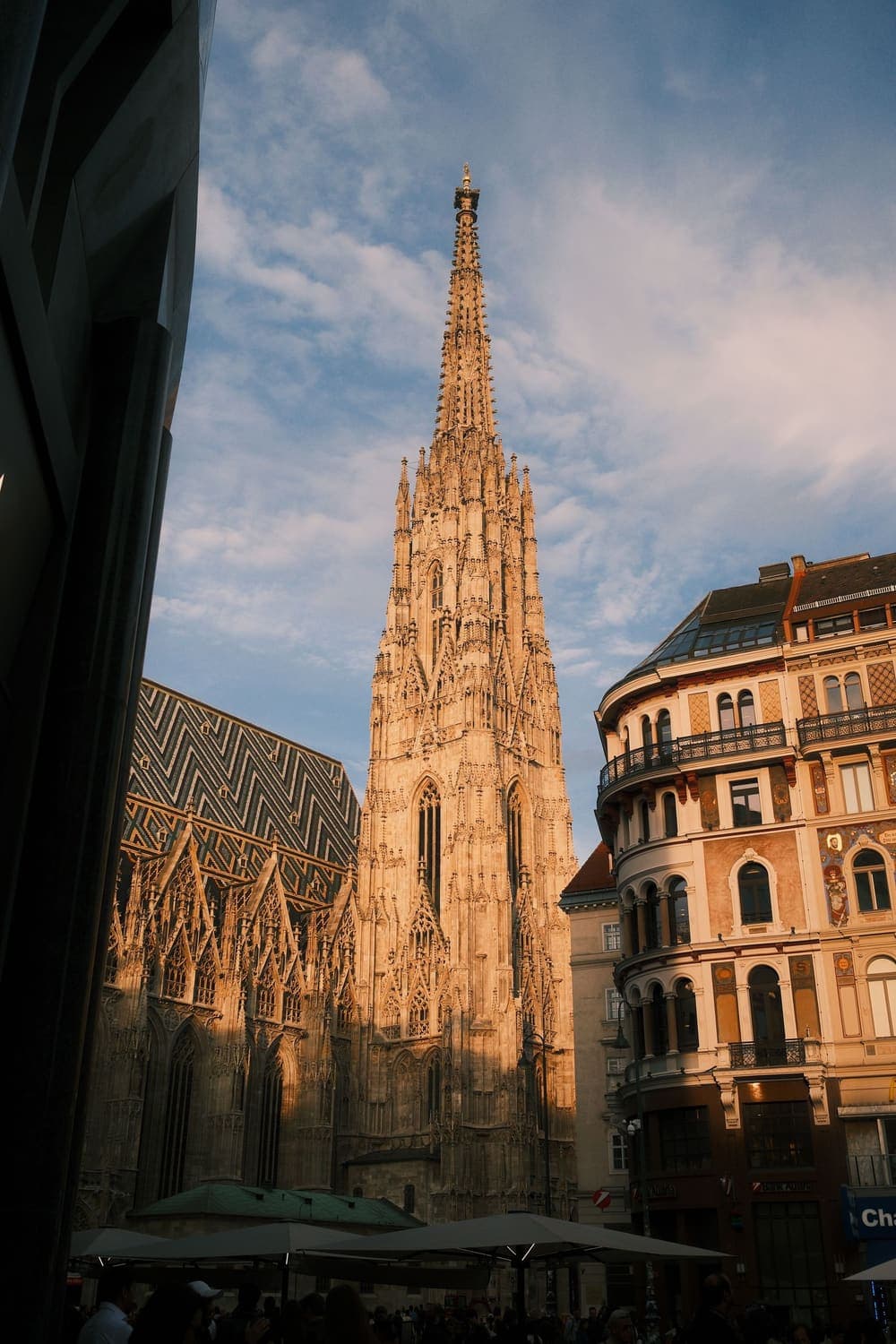
No single architect built St. Stephen's Cathedral. It grew over four centuries, paid for mostly by the people of Vienna, from a parish church first dedicated in 1147 to the Gothic cathedral you see today. The man who set its scale was Duke Rudolf IV, who laid a foundation stone himself in 1359. Master masons such as Hans von Prachatitz, who finished the south tower in 1433, and Anton Pilgram, who carved his own portrait inside, did the building.
The first church was founded in 1137, under an agreement between the Babenberg ruler Leopold IV and the Bishop of Passau, whose diocese then included Vienna. It was dedicated in 1147, probably before it was finished. A second, larger Romanesque church followed in the 1200s. Its west front survives, with the great main doorway known as the Giant's Door and the two square towers beside it.
From then on, the townspeople took charge of the money. Bequests, gifts and collections went into a building fund run by a church master, usually a wealthy city councillor. In the early 1300s the citizens paid for a new Gothic choir, the east end of the church, consecrated in 1340.
Rudolf IV became Duke of Austria in 1358, at eighteen. His father-in-law, the emperor Charles IV, ruled from Prague and was building a great cathedral there. Rudolf meant to match him.
He had his clerks forge a bundle of charters, including two supposedly from Julius Caesar and Nero, giving Austria's rulers special rights. Charles asked the poet Petrarch to examine them, and Petrarch dismissed them as absurd. Rudolf called himself archduke anyway.
In 1359 he laid the foundation stone for a vast Gothic nave around the old church, near where the south tower now stands. He set up a body of senior clergy here, a step towards Vienna having its own bishop, and built a family crypt under the choir. He died in Milan in 1365, aged twenty-five. Vienna finally got its bishop in 1469, under the emperor Friedrich III, and St. Stephen's became a cathedral.
The south tower, 136 metres high, took about sixty-five years and was completed under Hans von Prachatitz. Friedrich III began a matching north tower in 1450, but work stopped in 1511 at about half the height, and in 1578 it was given the rounded cap it still wears.
The cathedral workshop's master builders signed their work with masons' marks. Anton Pilgram, from Brno, took charge of the workshop in 1512 and carved himself, with compass and set square, under the stone organ base in the nave.
The last great rebuilding came after a fire in April 1945. Every Austrian province paid for a piece, from Lower Austria's stone floor to Upper Austria's new bell, and the cathedral reopened in 1952.
On the south side of the cathedral, find the Singer Gate, a side entrance in its own porch, with a glass door. Inside the porch, among the carved figures on the side walls, are Rudolf IV and his wife Catherine, the founders of the Gothic church.
The Trevlo tour St. Stephen's Cathedral tells Rudolf's story at its second stop, the Singer Gate. It starts at the Giant's Door and its mammoth bone, goes on to the South Tower and the siege of 1683, and to the Crucifix Chapel, where Mozart's body was blessed. Then it goes inside, under the giant organ that burned in 1945, and ends at the stone pulpit with its window-gazer. Six stops, about sixteen minutes of listening, at your own pace.
The first stop is free to play on this page, and your first tour in the app is free.