Stories · Vienna
Who is buried in St. Stephen's Cathedral in Vienna?
Duke Rudolf IV, Emperor Friedrich III and Prince Eugene of Savoy are buried in St. Stephen's, with urns of Habsburg organs and thousands of Viennese below.
3 min read

Stories · Vienna
Duke Rudolf IV, Emperor Friedrich III and Prince Eugene of Savoy are buried in St. Stephen's, with urns of Habsburg organs and thousands of Viennese below.
3 min read
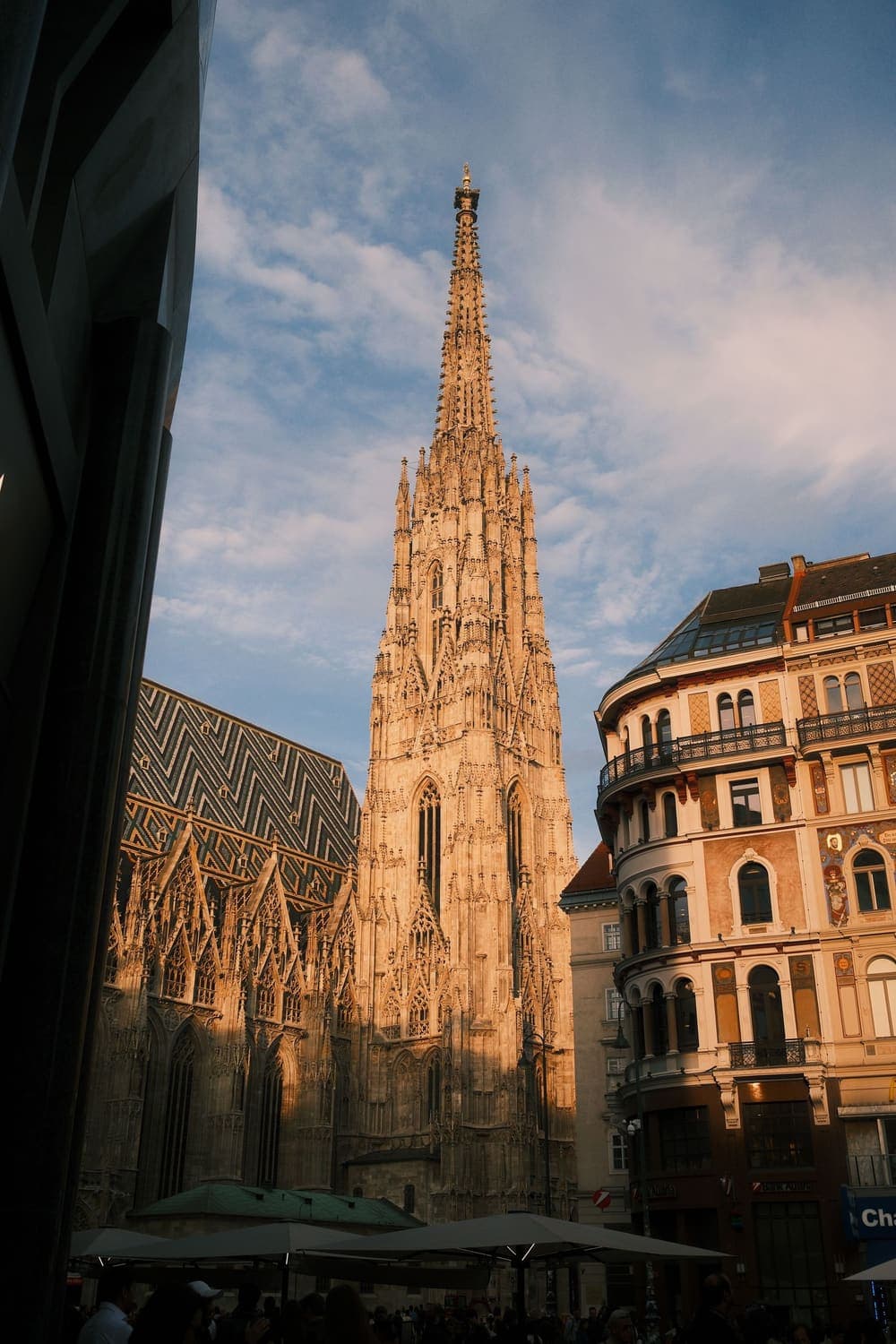
St. Stephen's Cathedral holds the remains of the man who began it, Duke Rudolf IV, and of the emperor who made it a cathedral, Friedrich III. Prince Eugene of Savoy, the general who beat the Ottomans, lies in a chapel in the nave. Under the floor, the catacombs hold urns with the internal organs of Habsburgs, bishops of Vienna, and the bones of thousands of ordinary Viennese.
Rudolf IV, Duke of Austria, built a burial crypt for his family under the choir before 1363, after the early death of his brother. He died in Milan in 1365, aged twenty-five, and was buried there. The ducal crypt remained the Habsburgs' most important family burial place until 1576.
Rudolf also had a grand monument carved for himself, with his figure lying on top. He never lay in it. It's an empty memorial, now standing in the north choir.
Friedrich III, the emperor who secured Vienna its own bishop in 1469, ordered his tomb long before he needed it. The sculptor Niclaes Gerhaert van Leyden carved the emperor's figure for the lid, but the whole tomb, of red marble with dozens of figures, took decades. When Friedrich died in 1493 it still wasn't ready. His body went into the ducal crypt and was moved into the finished tomb, in the south choir, on 12 November 1513. In 1945 a protective wall built around it saved it from the fire that wrecked the roof.
From 1564 until 1878, the Habsburgs divided their dead. Bodies usually went to the Capuchin Crypt nearby, hearts to the Augustinian Church, and the internal organs, in sealed copper urns, came here to the ducal crypt beneath St. Stephen's. They are still there.
Prince Eugene of Savoy, the commander who drove the Ottoman armies out of Hungary after the siege of 1683, died in Vienna in 1736. He was buried in the crypt of the Cross Chapel, at the north-west corner of the nave. Archbishops of Vienna are buried in a bishops' crypt laid out under the south choir in 1951.
For centuries the Viennese were buried in the churchyard that covered today's Stephansplatz. When it was closed in 1732, the cathedral dug new vaults under the choir and the square. Between 1745 and 1783 there were 10,893 burials in them, until Emperor Joseph II banned burials in churches and crypts.
Mozart is not among them. His body was blessed at the cathedral's Crucifix Chapel on 6 December 1791, the day after he died. He was then buried in St. Marx cemetery, outside the city walls.
On the north side of the cathedral, find the small Crucifix Chapel beside an outdoor stone pulpit with a gilded sunburst. It stands over the old way down to the catacombs, and Mozart's memorial plaque is on it. The catacombs themselves can be visited only on a guided tour, which starts inside the cathedral.
The Trevlo tour St. Stephen's Cathedral reaches the Crucifix Chapel at its fourth stop, with Mozart's wedding and funeral. It starts at the Giant's Door and its mammoth bone, then visits the Singer Gate, where Rudolf IV stands carved with his wife, and the South Tower. Inside, it stops under the giant organ that burned in 1945 and ends at the stone pulpit. Six stops, about sixteen minutes of listening, at your own pace.
The first stop is free to play on this page, and your first tour in the app is free.