Who built the Petronas Towers?
The Petronas Towers were designed by César Pelli and built by two rival teams: a Japanese group led by Hazama, and a Korean one led by Samsung.
3 min read

The Petronas Towers were designed by César Pelli and built by two rival teams: a Japanese group led by Hazama, and a Korean one led by Samsung.
3 min read
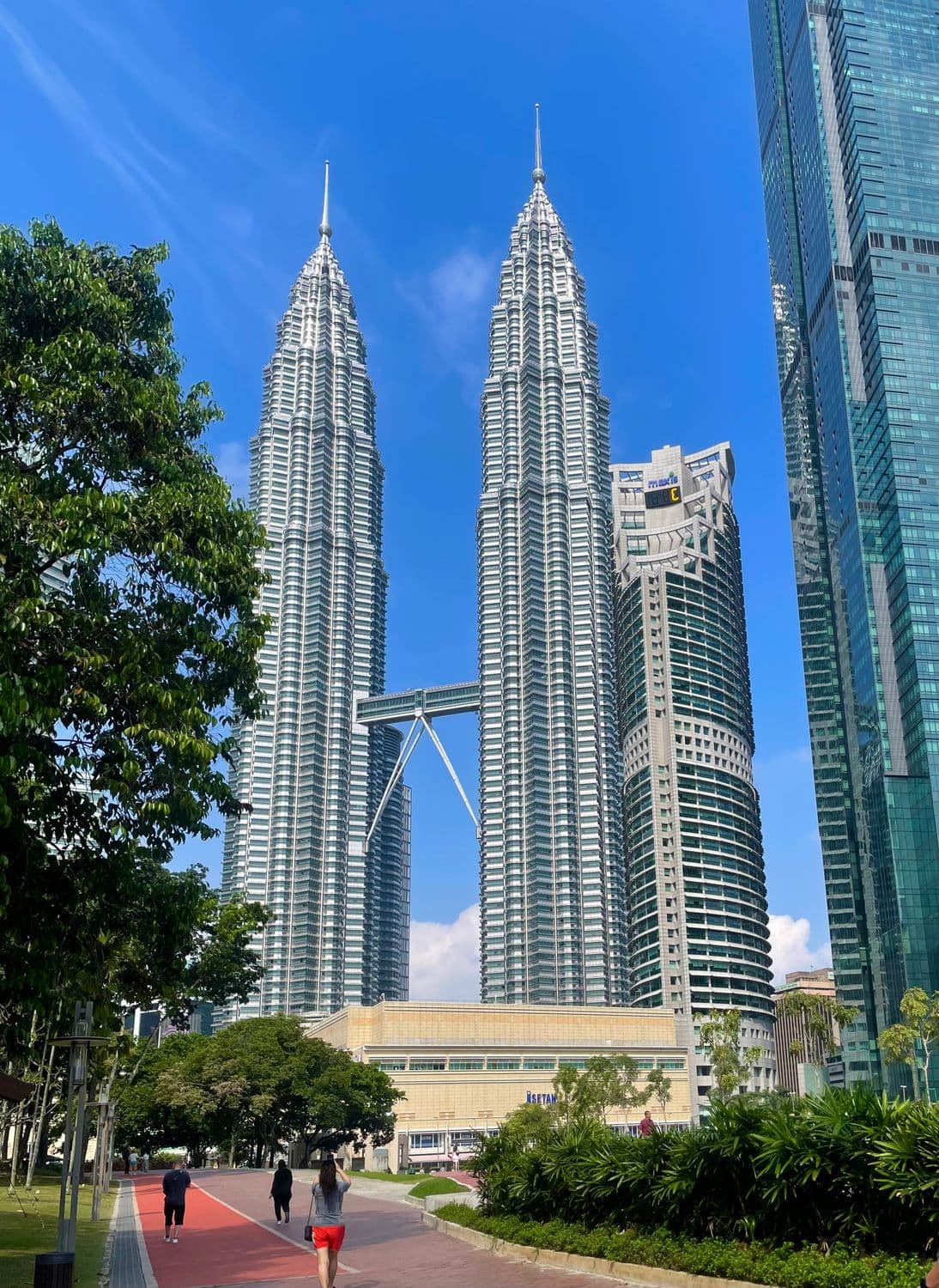
Malaysia's government wanted the towers finished in six years, so it hired two construction groups, one for each tower. They were built for Petronas, Malaysia's national oil company, with the strong backing of the prime minister, Mahathir Mohamad. When their spires went on in 1996, they became the tallest buildings in the world, a title they held until 2004.
The site was a racecourse, home of the Selangor Turf Club for nearly a century, in the middle of Kuala Lumpur, Malaysia's capital. In 1991 eight international firms drew up designs for offices there. The winner was César Pelli, an Argentine-born architect based in New Haven, Connecticut.
Malaysia wanted the buildings to look Malaysian. Each tower's floor plan is an eight-pointed star made of two overlapping squares, a pattern from Islamic art, the art of Malaysia's main religion. Pelli added curved sections between the points to fit in more office space.
The ground caused trouble before anything rose. Test boreholes showed that part of the site sat on the edge of an underground cliff, with crumbling limestone on one side and softer rock on the other. The whole plan was moved about 61 metres (200 feet) so the towers sat entirely on the softer rock. They stand on concrete piles up to 114 metres (374 feet) deep, then the deepest foundations of any building.
Tower 1, the west tower, went to a consortium led by the Japanese firm Hazama Corporation. Tower 2, the east tower, went to a South Korean consortium led by Samsung, with the firm Kukdong Engineering & Construction.
The two teams rose side by side in a friendly race. The Korean team, by most accounts, started about a month later and still reached the top first.
Kukdong also built the skybridge. It was assembled on the ground, then lifted into place over three days in July 1995. The two-storey bridge links the 41st and 42nd floors, 170 metres (558 feet) up. It is not rigidly fixed, so each tower can sway in the wind on its own. In an emergency, people can cross it to the other tower.
In March 1996 the stainless-steel spires were fixed on top, taking each tower to 452 metres (1,483 feet). Chicago's Sears Tower, now the Willis Tower, had held the record at 442 metres (1,450 feet). It also had antennas on its roof that reached far higher than the Malaysian spires.
In April 1996 the Council on Tall Buildings and Urban Habitat, which keeps the official list, ruled that spires are part of a building and antennas are not. Chicago objected, and lost. The towers were officially opened in August 1999 by Mahathir. Their record lasted until Taipei 101 in Taiwan was finished in 2004. As of 2026 they are still the tallest twin towers in the world.
Stand on the plaza between the two tower bases, under the skybridge. Look up at the bridge and the slim arch beneath it. The arch's two legs lean down to the 29th floor of each tower and carry the bridge's weight. The Japanese team built the west tower, and the Korean team the east tower and the bridge.
The Trevlo tour of the Petronas Twin Towers tells this story on the plaza between the towers, its second stop. It starts on the lawn of KLCC Park, visits the Tower One entrance and the Suria KLCC mall, and ends at Lake Symphony with the towers reflected in the water. Five stops, about twenty-three minutes of listening, at your own pace.
The first stop is free to play on this page, and your first tour in the app is free.