Stories · Paris
Who is buried in the Arc de Triomphe?
An unidentified French soldier of the First World War lies under the Arc de Triomphe. He was buried there on 28 January 1921, and nobody knows his name.
2 min read

Stories · Paris
An unidentified French soldier of the First World War lies under the Arc de Triomphe. He was buried there on 28 January 1921, and nobody knows his name.
2 min read
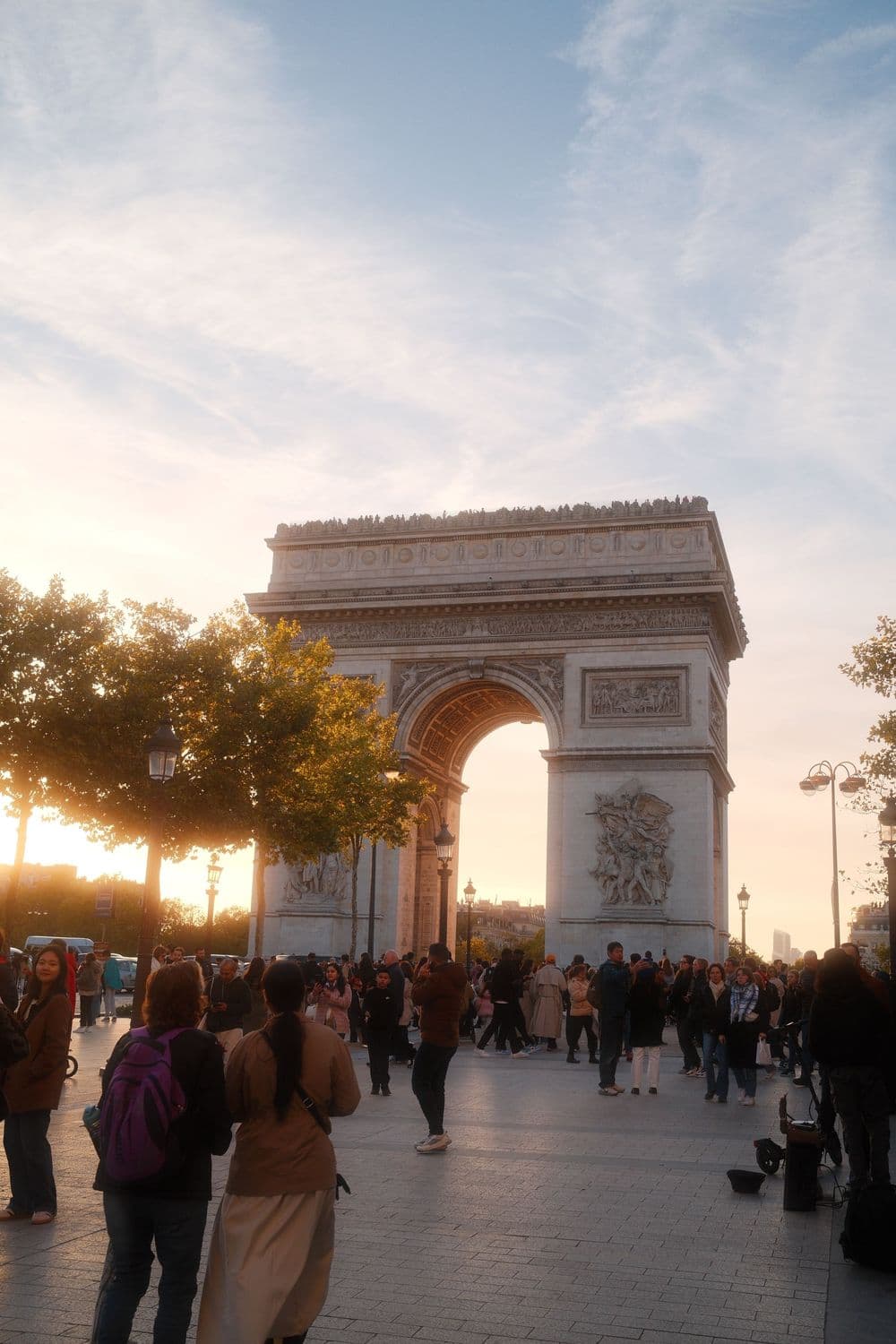
He was chosen from eight unidentified dead at Verdun in November 1920, by a 21-year-old soldier called Auguste Thin. The coffin reached Paris on 11 November, the second anniversary of the Armistice. It stayed inside the Arc, watched day and night, for eleven weeks before it was buried under the vault, where a flame now burns beside it.
The idea came during the war itself. In 1916 François Simon, who led a war-memorial society in Rennes, proposed honouring one unidentified soldier on behalf of all of them.
After the war, the first plan was the Panthéon, the domed resting place of France's great men in the Latin Quarter. Veterans pushed for the Arc instead. A soldier belonged under a monument to soldiers, they argued, and the Panthéon had begun life as a church. On 8 November 1920 parliament voted unanimously for the Arc.
Eight oak coffins were laid out in the underground citadel at Verdun. Each held an unidentified Frenchman from a different battlefield, from Flanders in the north to Lorraine in the east.
On 10 November 1920, André Maginot, the minister of pensions and himself a wounded veteran, handed Thin a bunch of carnations. Thin was to place them on one coffin. He walked along the row twice and stopped at the sixth.
He later explained his arithmetic. He served in the 6th Army Corps, and the digits of his regiment, the 132nd, add up to six. The other seven soldiers were buried in a cemetery at Verdun.
The next morning the coffin came through Paris. It stopped at the Panthéon, where the heart of Léon Gambetta, the statesman who had led France's resistance in the war of 1870, was being moved in the same ceremony. Then it rode on the carriage of a field gun to the Arc de Triomphe.
On that same day in London, Britain buried its Unknown Warrior in Westminster Abbey. The two were the first tombs of their kind. France held its burial back until 28 January 1921.
The flame came later. Gabriel Boissy, a Paris journalist, proposed a flame that would never be left to go out. Maginot, by then minister of war, lit it for the first time on 11 November 1923. Veterans' associations have rekindled it every evening since. As of October 2026, the ceremony starts at 6.30 pm.
Take the underpass to the base of the Arc and walk to the centre, under the great vault. The flame rises from a bronze ring in the paving, shaped around the mouth of a cannon pointing upwards. Look at the granite slab beside it. In French, it reads: "Here rests a French soldier who died for the fatherland, 1914–1918."
The Trevlo tour of the Arc de Triomphe tells this story at its last stop, the Tomb of the Unknown Soldier. Before that, it starts on the pavement ring of Place Charles de Gaulle, goes under the vault, and looks at the Marseillaise relief and the west face. Five stops, about twenty-six minutes of listening, at your own pace.
The first stop is free to play on this page, and your first tour in the app is free.