Stories · Rio de Janeiro
Why did the Portuguese royal family move to Brazil?
To escape Napoleon. Portugal wouldn't turn on Britain, so his army marched on Lisbon, and in 1807 the court sailed for Brazil under British escort.
3 min read

Stories · Rio de Janeiro
To escape Napoleon. Portugal wouldn't turn on Britain, so his army marched on Lisbon, and in 1807 the court sailed for Brazil under British escort.
3 min read

To get out of Napoleon's reach. In 1807 he ordered Portugal to shut its ports to Britain, its oldest ally, and when Prince João would only half obey, a French army marched on Lisbon. On 29 November the royal family and their court sailed for Brazil with British warships alongside, and the French walked into Lisbon the next day. Rio de Janeiro was the capital of a European empire until 1821.
Portugal had been caught between the two great powers of the age. Napoleon was trying to starve Britain of trade by closing every port in Europe to it, and Portugal depended on Atlantic trade and its long alliance with Britain. That August the French and Spanish ambassadors handed João their demands: declare war on Britain, give up his fleet, seize the British merchants in his ports and arrest every British subject. João, ruling for his ailing mother, Queen Maria, agreed to close the ports, but he could not bring himself to seize the merchants, and that was not enough.
On the first of November word reached the court that Napoleon had announced the House of Braganza would stop reigning within two months. Five days later a British squadron sailed into the Tagus with orders to carry the family to Brazil, or, if the government gave in to the French, to attack Lisbon. A secret deal had been signed in London two weeks before: British protection, in return for British ships being let into Brazil's ports.
So it was a flight, but not a blind one. A Portuguese diplomat had argued early in the 1700s that the monarchy's survival might one day depend on Brazil, so big and rich was it. The court went aboard on the twenty-seventh, waited two days for the weather, and left in such a rush that carts of treasure, and the crates of the royal library, were left behind on the quay. The old queen, the story goes, asked everyone to slow down, or it would look as if they were fleeing. Junot marched into Lisbon with about fifteen hundred ragged men and not one cannon, and found the fleet gone.
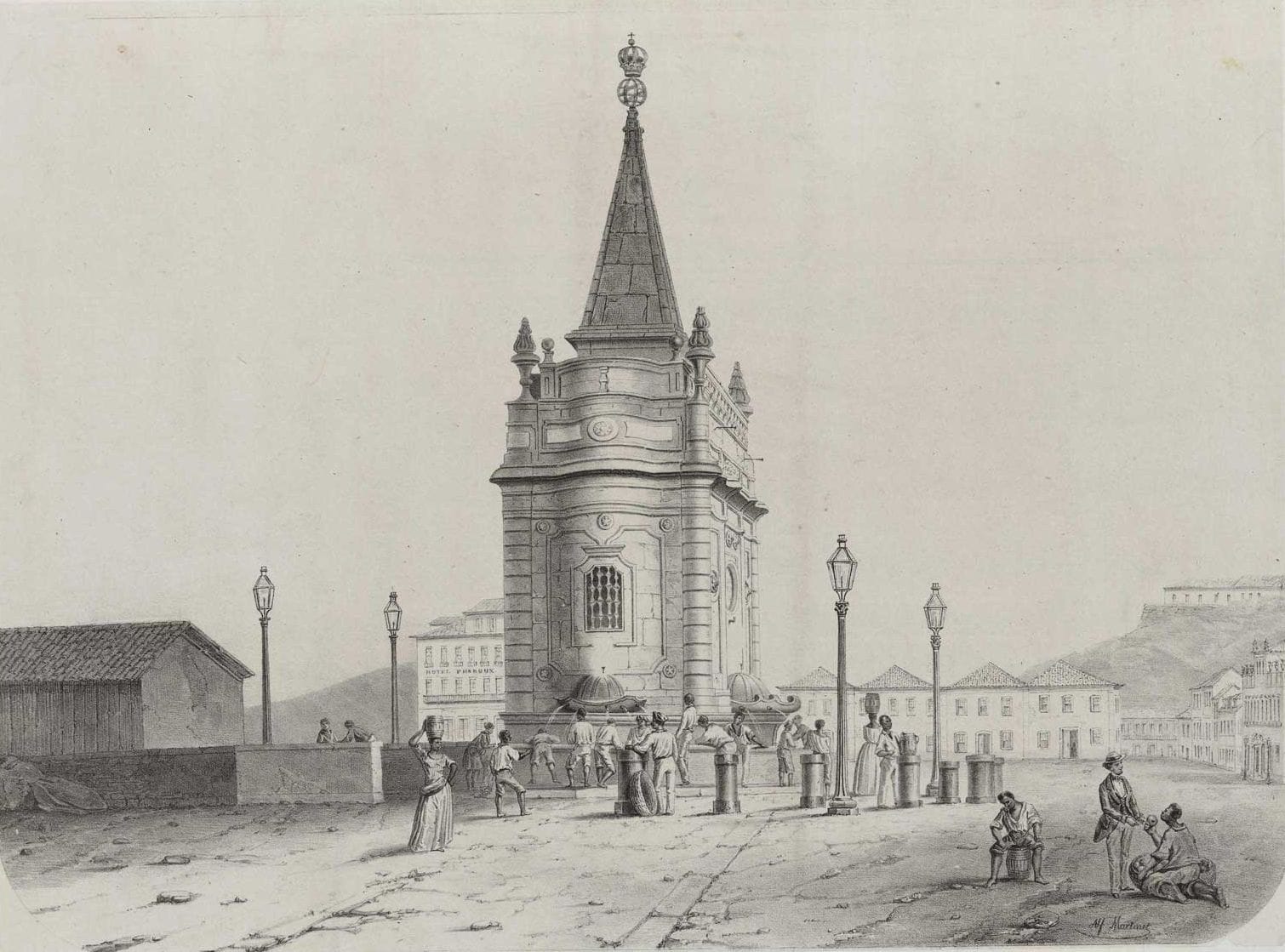
In January 1808 João put in at Salvador and opened Brazil's ports to friendly nations, Britain first among them. Then he sailed south, and on the afternoon of 7 March his ships anchored in Guanabara Bay. At four the next day he came ashore at the Largo do Paço, by the fountain on the water's edge, where an altar waited at the head of the landing ramp, and for nine days the city stayed lit. Families begged for windows along his procession, and people climbed onto roofs to see him. Nobody counted how many came with him; modern historians reckon a few thousand, landing in a town of about sixty thousand.
When João sailed home in 1821, he left his son Pedro behind, and the next year Pedro declared Brazil independent. On Saint Helena, Napoleon is supposed to have said that João was the only one who ever fooled him.
Go to Praça XV and find the granite fountain with the small pyramid on top. Look down into its pool: the stone steps at the bottom were buried when the square was raised in 1857 and dug out again in 1988. Those steps mark the shoreline of his day, and the prince came up the landing ramp beside them. The long white palace across the square became his that year.
Rio's Old Capital: Historic Centro is nine stops, about 49 minutes of listening. It walks backwards through Rio's history, from the square the young Republic laid out to the palace where slavery ended, and finishes at this fountain, where the court came ashore.
A free preview of the tour plays on this page, and your first tour in the app is free.