Stories · Paris
Why is it called the Latin Quarter in Paris?
The Latin Quarter is named after the language of its medieval university. Students and teachers on the Left Bank studied, argued and lived in Latin.
2 min read

Stories · Paris
The Latin Quarter is named after the language of its medieval university. Students and teachers on the Left Bank studied, argued and lived in Latin.
2 min read
From the 1100s, teachers drew students to the Montagne Sainte-Geneviève, the hill just south of the Seine. Their university taught in Latin, the shared language of educated Europe, so a student from England, Germany or Italy could follow every lecture. Latin stayed in the lecture halls for centuries. The Revolution closed the old university in 1793, but the name stuck to the streets.
Peter Abelard, a brilliant and famously argumentative teacher of the 1100s, was one of the first to pull crowds of students up the hill. By 1200 the masters and students had formed a corporation of their own, and King Philip Augustus gave it legal privileges. That body became the University of Paris.
Students came from all over Europe. They were grouped into four "nations": France, Normandy, Picardy and England, which also took in the Germans. Latin was the one language they all had in common. They used it in lectures and in exams, and they were expected to use it outside class too.
One of the many colleges on the hill later lent its name to the whole university. Robert de Sorbon was born in 1201 to a peasant family in Sorbon, a village in the Ardennes. He had been a poor student himself, living on charity. He rose to become chaplain to King Louis IX.
In 1257 the king gave him houses on a narrow lane called Rue Coupe-Gueule, which means Cut-Throat Street. Robert opened a college there for poor students of theology. It began with about twenty of them, who got a room, meals and free teaching.
The college took his name, the Sorbonne. Over the centuries people used that name for the University of Paris itself, and they still do.
By the 1500s the Latin-soaked talk of Paris students was a joke. In Pantagruel, published in 1532, François Rabelais has his giant hero meet a student from Paris. The young man speaks French stuffed with Latin words. He says that he and his friends cross the "Sequane", the Seine, at dawn and dusk, and stroll the "quadrivies" of the "urbe", the crossroads of the city.
Pantagruel loses patience and grabs him by the throat. He tells the student he is skinning Latin. The terrified young man at once forgets his Latin and begs for mercy in the plain dialect of Limousin, his home region.
Walk to Place de la Sorbonne, the small square that opens off Boulevard Saint-Michel, and face the domed chapel at its far end. Cardinal Richelieu, the powerful chief minister of Louis XIII, had it rebuilt between 1635 and 1642. He is buried inside.
Look up at the dome. The university buildings around it stand on the ground where Robert de Sorbon's little college for poor students grew.
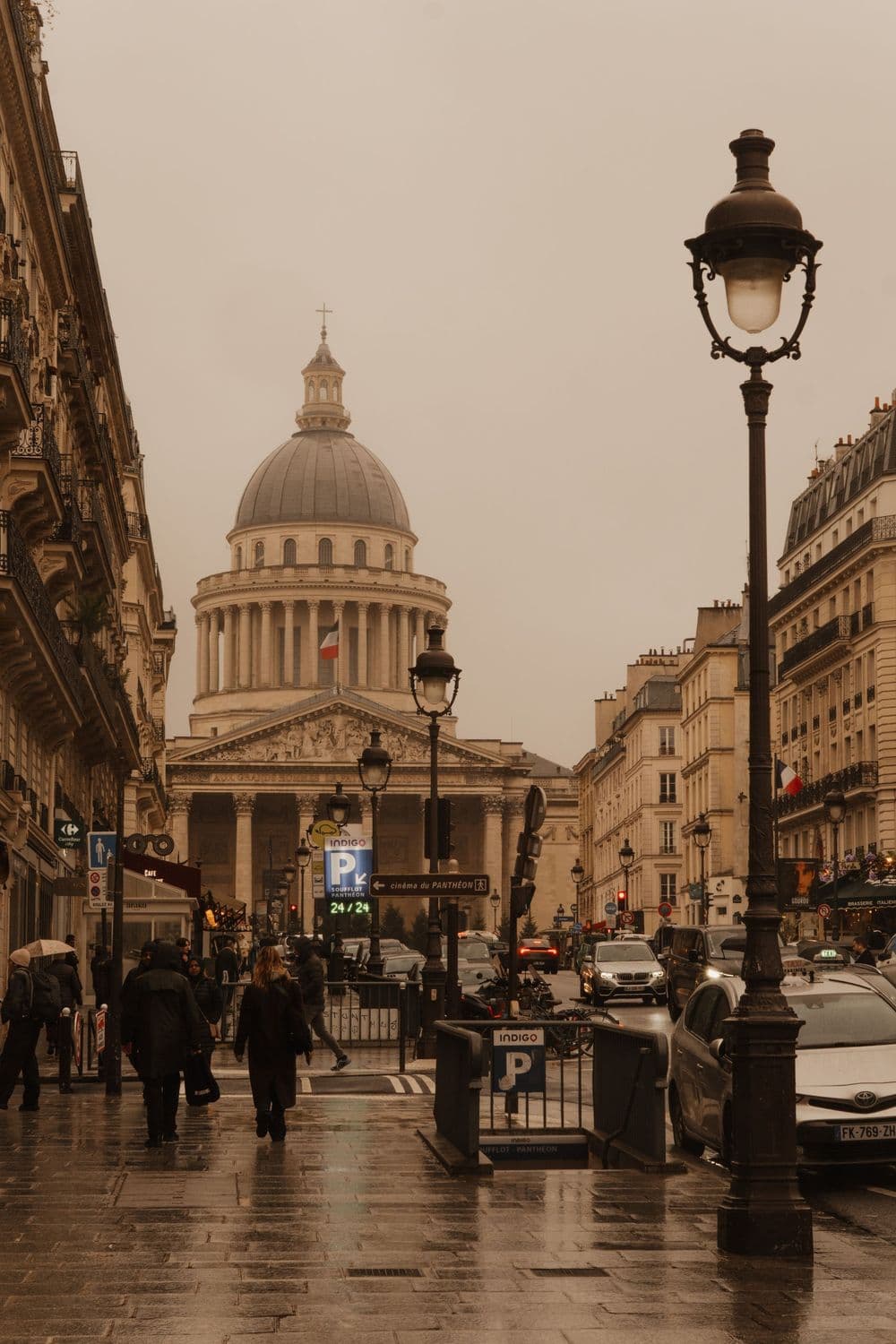
The Trevlo walk through the Latin Quarter explains the name at its first stop, the Panthéon, and reaches the Sorbonne at its fourth. On the way it goes down Rue Mouffetard to Place de la Contrescarpe, and it ends at the Roman baths of Cluny. Five stops, about twenty-one minutes of listening, at your own pace.
The first stop is free to play on this page, and your first tour in the app is free.