Stories · Singapore
Why were the Supertrees built?
The Supertrees at Singapore's Gardens by the Bay are vertical gardens built to give a flat, reclaimed site height and to vent air for its cool glasshouses.
3 min read

Stories · Singapore
The Supertrees at Singapore's Gardens by the Bay are vertical gardens built to give a flat, reclaimed site height and to vent air for its cool glasshouses.
3 min read
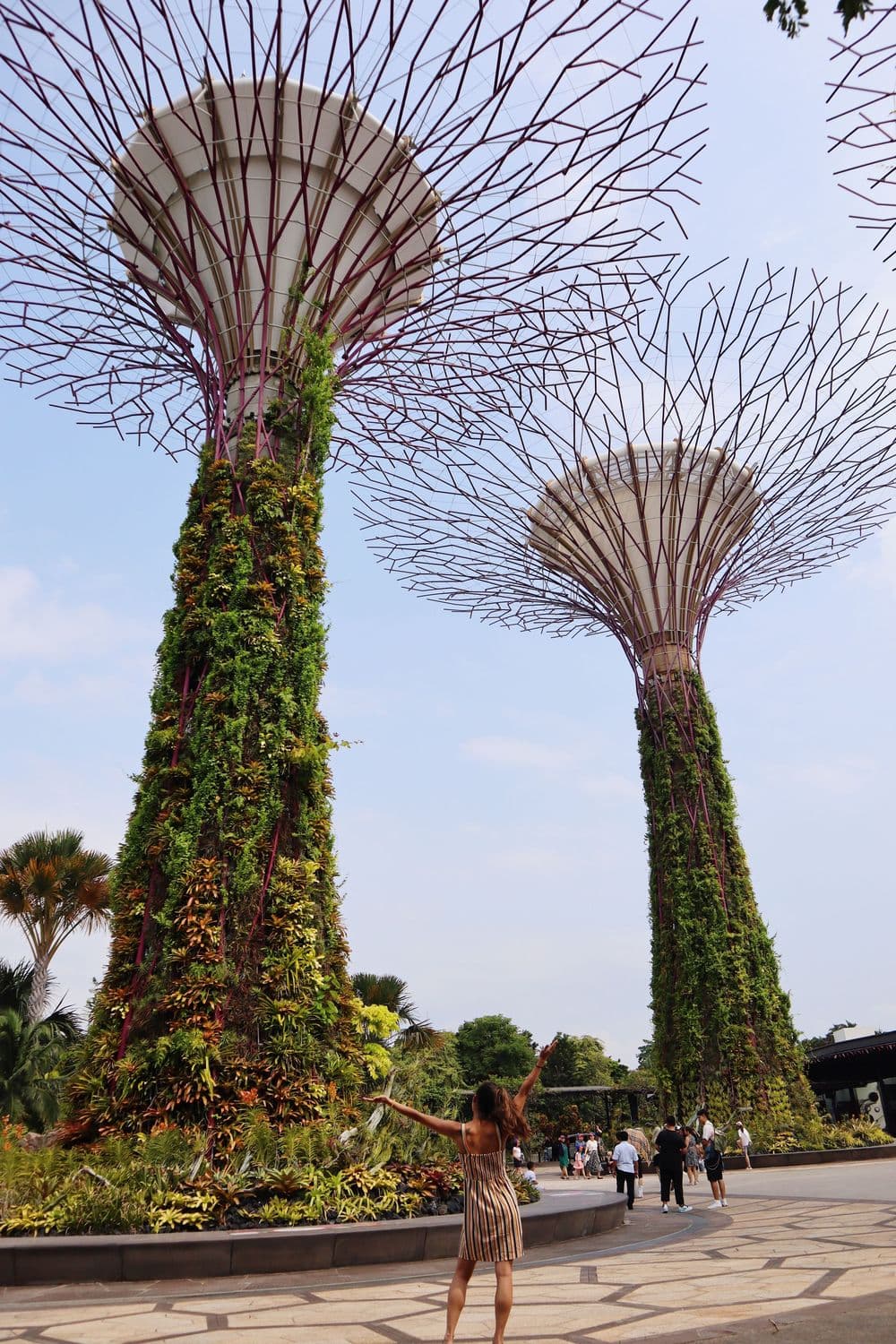
There are 18 of them, from 25 to 50 metres (about 80 to 165 feet) tall. The tallest is about as high as a 16-storey building. Twelve stand together in the Supertree Grove. They were designed by Grant Associates, British landscape architects who won an international competition for the gardens in 2006, and opened with the park on 29 June 2012.
In 2005 Singapore's prime minister, Lee Hsien Loong, announced a huge new garden on the waterfront at Marina Bay. It was part of a plan to turn Singapore from a "Garden City" into a "City in a Garden".
The site, called Bay South, was 54 hectares (about 130 acres) of land reclaimed from the sea, beside a new downtown. At the opening, Lee said it had not been an easy decision. The land could have been used for far more valuable offices or homes.
Andrew Grant, who founded the firm, faced a site as flat as a table. One of the team's main aims was to break up that flatness.
Grant has described two inspirations. One was the Valley of the Giants in south-western Australia, where karri trees grow to around 70 metres, as tall as a 20-storey building. The other was the enchanted forest of Princess Mononoke, an animated film by the Japanese studio Studio Ghibli.
The whole plan of the gardens is based on Singapore's national flower, an orchid called Vanda Miss Joaquim. Its shoots became the paths, its blooms the themed gardens, and the Supertrees stand where paths meet.
The aim was trees that felt like trees without copying them. Each Supertree has four parts: a concrete core, a steel trunk, planting panels that form a living skin, and a canopy shaped like an upturned umbrella. Some 162,900 plants of over 200 kinds grow on them: ferns, orchids, bromeliads and climbers.
The Supertrees also work for the two great glasshouses beside them, the Flower Dome and the Cloud Forest. Both are kept cool and dry in a city that is hot and humid all year.
Several Supertrees carry air intakes and exhausts for the glasshouses' cooling plant. A boiler on the site burns chipped prunings from Singapore's street trees to help power that cooling, and its cleaned fumes leave through a Supertree, high above the visitors' heads. So one of the most photographed trees in Singapore is, among other things, a chimney.
Eleven of the trees have environmental jobs like this, including solar panels, and some collect rainwater. After dark, all of them become the stage for a light and music show called Garden Rhapsody.
Stand in the Supertree Grove, under the canopies. Look up at the nearest trunk. The plants grow from panels fixed to its steel frame, climbing towards the canopy.
For a closer view, the OCBC Skyway, a walkway 22 metres (72 feet) up, runs between two of the larger trees.
The Trevlo tour of Gardens by the Bay tells this story in the Supertree Grove, its second stop. It starts at the entrance plaza, climbs to the OCBC Skyway, visits the Flower Dome and the Cloud Forest, and ends in the Heritage Gardens. Six stops, about twenty-eight minutes of listening, at your own pace.
The first stop is free to play on this page, and your first tour in the app is free.