Stories · Paris
Why does the Eiffel Tower look like that?
Because of the wind. Its legs spread wide and curve inward as Eiffel's wind calculations required, and its open lattice lets storms blow through.
3 min read

Stories · Paris
Because of the wind. Its legs spread wide and curve inward as Eiffel's wind calculations required, and its open lattice lets storms blow through.
3 min read
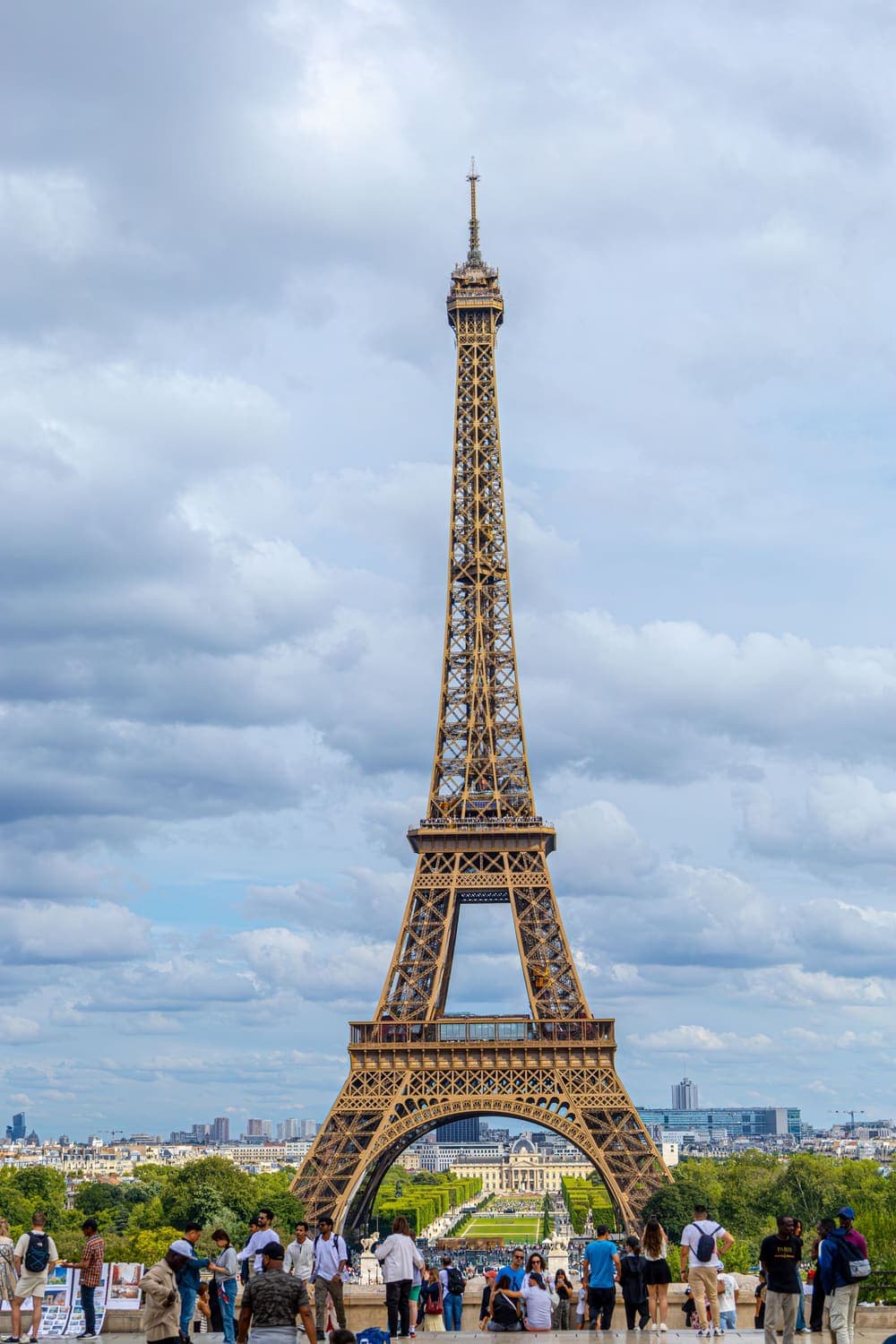
Almost everything about the shape of the Eiffel Tower comes from one problem, the wind. The higher the wind strikes a tall structure, the more leverage it has to topple it, so the base has to be broad, while higher up the legs can afford to be slender. The sweep of the four edges, from a square base 125 metres across, is the line Gustave Eiffel's calculations produced. The iron is a lattice for the same cause. Solid walls would give a gale something to shove against, and gaps give it far less. The one big feature made purely for the eye is the four arches between the legs, which carry no load at all.
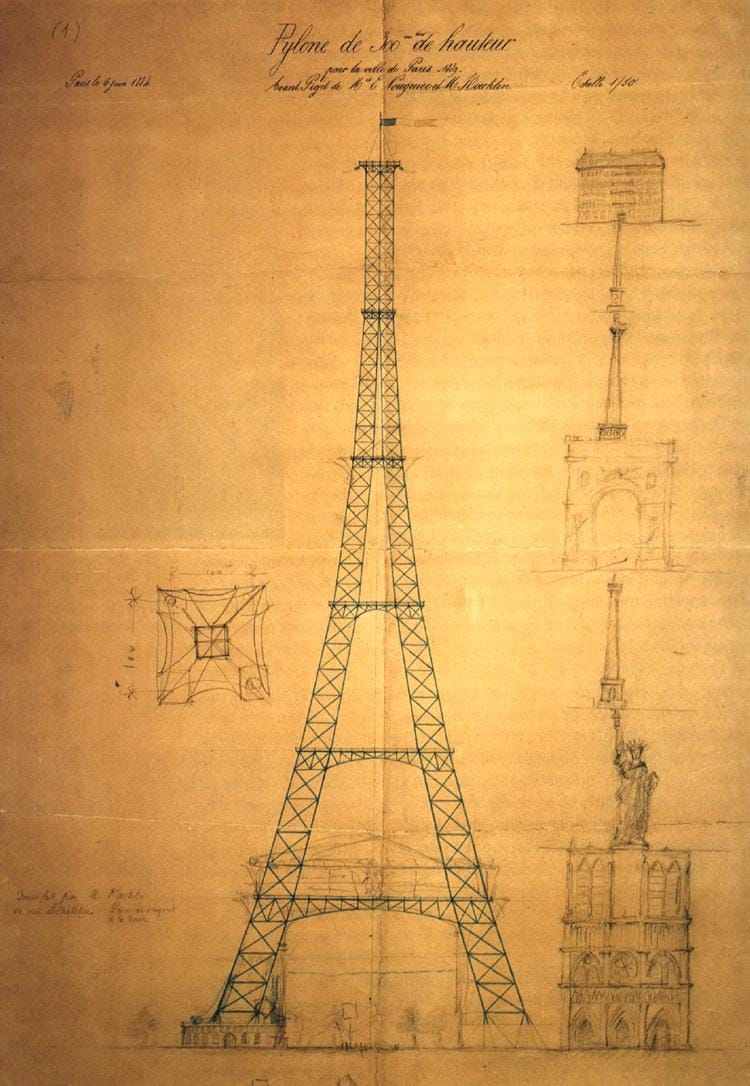
The tower began as someone else's drawing. On the evening of 6 June 1884, Maurice Koechlin, head of the design office at Eiffel's firm, sketched at home a pylon 300 metres tall, made of four lattice girders set apart at the base and joined at the summit. Beside it, to make the height mean something, he stacked the landmarks of Paris one above another, Notre-Dame and the Arc de Triomphe among them, and the stack still doesn't reach his tip.
Koechlin and a fellow engineer, Émile Nouguier, took it to Eiffel, who told them he had no interest in it. So they asked Eiffel's architect, Stephen Sauvestre, to make it handsome. He gave it heavy stone feet, cut the platforms from five to two, and drew in the arches, which made the pylon look more substantial and gave the world's fair of 1889 a grand entrance. Eiffel came round, patented the design that September in all three names, and in December bought out the two engineers.
The curve of the legs, though, was still the engineers' work, and Eiffel defended it in engineers' terms. In February 1887 a protest in Le Temps against "the useless and monstrous Eiffel Tower" carried forty-seven famous names. Eiffel replied in the same paper. The condition he had to respect before any other, he said, was resistance to the wind, and the curved edges, just as the sums had drawn them, would let people see the daring of the whole design. He had cause to take wind seriously. In 1884 a storm had flung a viaduct his firm was building over the Tardes down into the gorge.
Before they meet at such an impressive height, the uprights appear to spring out of the ground, moulded in a way by the action of the wind itself.
In 2004 two researchers, Patrick Weidman and Iosif Pinelis, modelled the tower from Eiffel's own reasoning and found him right: the profile does follow the wind's push. Up close it is really two curves, each climbing at its own rate, which they explain by the safety margins his firm added.
Even the paint helps. The tower is coated in three shades of brown, deepest near the ground and palest near the summit, so that seen from below it reads as a single colour.
Head for the centre of the esplanade, between the four legs, and look up through the ironwork to the sky. Then choose one leg and trace its outside edge upward, from its broad foot to where it slims. For the whole profile in one view, cross the river to the terrace of the Trocadéro.
The Eiffel Tower tour has nine stops, about 36 minutes of listening, from the security queue up to the summit and back down. Its second stop, Shaped by the Wind, is heard standing under the legs, with Koechlin's sketch, Sauvestre's arches and the curve the wind decided. Higher up come the sandboxes that joined the legs and the army captain whose radio saved the tower.
A free preview of the tour plays on this page, and your first tour in the app is free.